
Cao Bang motorbike tour guide 2026: routes, stops, and what to expect
Cao Bang sits in the northeastern corner of Vietnam, 270 km from Hanoi along Highway 3, bordering China to the north. It is one of the least commercially developed provinces in the country, which is exactly why riders who have already done Ha Giang or the northwest come here next.
The landscape is built around the Cao Bang Geopark, a UNESCO-recognised limestone karst system covering 3,275 square kilometres. Ban Gioc Waterfall, 300 metres wide and split by the Vietnamese-Chinese border, anchors the northern end of the riding circuit. Getting there means crossing passes like Ma Phuc, Khau Lien and Ngoc Khe, where the road climbs through cloud forest before dropping into river valleys with no other traffic in sight.
This guide covers the practical side of riding Cao Bang in 2026: when to go, which roads to take, what each stop is actually worth, how long to budget, what it costs, and what IRTouring runs on this circuit for riders who want a structured departure.
- Browse our Ha Giang loop motorbike tours
- See our northern Vietnam motorcycle tours
- View all motorbike tours Vietnam
When to Ride Cao Bang
Cao Bang is accessible year-round, but the riding experience changes significantly by season. The province sits at elevation and the roads through the passes can become genuinely dangerous in winter fog or after sustained rain.

February to April
Temperatures sit between 15°C and 22°C across most of the province. The mountain roads are dry and the landscape is at its most colourful, with peach and plum blossom covering the lower slopes in February and March. Tourist numbers are low following Tet, which means guesthouses near Ban Gioc have availability without advance booking. A good window for riders who want the passes without the rain.
May to August
The wet season brings temperatures up to 28 to 32°C in the valleys and heavy afternoon rain across most of the province. Ban Gioc Waterfall runs at its most powerful during this period and the Quay Son River fills enough to allow boat access to the base. The trade-off is road condition: the unpaved sections near Pac Bo and the track approaching Nguom Ngao Cave become muddy after consecutive rain days. Check conditions locally before committing to off-road sections.
September to November
This is the best window for a Cao Bang motorbike tour. Rain eases off from September, road surfaces dry out, and the terraced rice fields above the Quay Son River turn gold through October before the harvest. Temperatures are stable between 18°C and 26°C. The Ma Phuc Pass is at its clearest and the landscape around Khuoi Ky Stone Village is easier to photograph without haze. Book accommodation near Ban Gioc at least two weeks in advance during October.
December to January
Winter is the hardest season to ride. Temperatures drop to 3 to 8°C at elevation, and dense morning fog sits on the passes until 9 or 10 am. The roads are not icy at lower elevations but the Ngoc Khe Pass can be slippery after a cold night. Riders willing to start late and go slow will find Cao Bang almost empty of tourists, with village life slowed to its quietest pace. Not recommended for first-time mountain riders.
The Main Riding Circuit: Hanoi to Cao Bang and Ban Gioc
The standard loop covers approximately 600 km and takes three to five days depending on how long you spend at each stop. Most riders depart Hanoi via Highway 3 through Thai Nguyen and Bac Kan, reaching Cao Bang city after 270 km and around five to six hours of riding.
From Cao Bang city, the route north to Ban Gioc Waterfall covers 90 km via the Ma Phuc Pass and through Trung Khanh district. The road is paved throughout but narrow in places. The Ma Phuc Pass sits at around 600 metres and has tight switchbacks on both sides. Morning is the best time to cross it; the light is good and traffic is minimal.
The return to Hanoi can follow the same route or loop south via Ba Be National Park, adding roughly 150 km and one overnight stop. The Ba Be extension is worth taking if you have an extra day; the road through Bac Kan province is some of the quietest riding in the northeast.
IRTouring runs guided departures on this circuit combining Cao Bang with Ha Giang and Ba Be for riders who want to extend the trip across the full northeast loop.
Sample Four-Day Itinerary
This is the base itinerary IRTouring uses for most Cao Bang departures. Times are approximate and vary with group pace and conditions.
Day one — Hanoi to Cao Bang city
7:00 am — Depart Hanoi heading north on Highway 3
10:30 am — Stop in Thai Nguyen for coffee and fuel
1:00 pm — Lunch in Bac Kan town
4:00 pm — Arrive Cao Bang city; check in and walk the evening market on Bang Giang River
270 km total riding
Day two — Cao Bang city to Ban Gioc via the passes
7:30 am — Depart Cao Bang city heading north
9:00 am — Cross Ma Phuc Pass; stop at the summit viewpoint
10:30 am — Stop at Pac Bo Cave and Lenin Stream in Ha Quang district
1:00 pm — Lunch in Trung Khanh town
2:30 pm — Arrive Ban Gioc Waterfall; afternoon at the falls
5:30 pm — Check in at guesthouse in Ban Gioc village
90 km total riding
Day three — Ban Gioc area exploration
8:00 am — Morning ride to Nguom Ngao Cave; 30-minute walk through the cave system
10:30 am — Ride to Khuoi Ky Ancient Stone Village; 3 km from the waterfall
1:00 pm — Lunch in Trung Khanh
2:30 pm — Ride to Thang Hen Lake via the plateau road above Tra Linh
5:00 pm — Return to Ban Gioc or overnight in Tra Linh
60 km total riding
Day four — Ban Gioc back to Hanoi
7:00 am — Depart Ban Gioc heading south
9:30 am — Stop at Mat Than Mountain viewpoint above Thang Hen
12:00 pm — Lunch in Cao Bang city
1:30 pm — Continue south via Highway 3
6:30 pm — Arrive Hanoi
360 km total riding
Extensions into Ba Be National Park and the full northeast loop are available through IRTouring for riders who want to combine Cao Bang with Ha Giang or Bac Ha.
Stops Worth Riding To
Ban Gioc Waterfall
Ban Gioc is the largest waterfall in Vietnam and one of the widest in Asia, spanning 300 metres across the Vietnamese-Chinese border. The main drop is roughly 30 metres. The Quay Son River above the falls is navigable by traditional wooden boat from September to April when water levels allow a close approach to the base.
The viewpoint area on the Vietnamese side is well-maintained, with a paved path running along the river bank. Arrive before 9 am to avoid tour groups arriving from the Chinese side. Entry costs 45,000 VND per person. The falls run strongest from July to October; in February and March the flow drops but the surrounding landscape is clearer.
Ma Phuc Pass
Ma Phuc sits at around 600 metres between Cao Bang city and Trung Khanh district. The road climbs through a narrow gorge before opening to views across the karst plateau. The surface is paved but worn in sections, with tight switchbacks on the northern descent. It is the most technically demanding part of the main circuit and the most rewarding. On a clear morning the valley below holds mist until 8 am and the riding through it is exceptional. Wet season riders should take it slowly on the way down; the tarmac becomes slick after rain.
Pac Bo Cave and Lenin Stream
Pac Bo is where Ho Chi Minh lived and worked after returning to Vietnam in 1941 following 30 years abroad. The site includes the cave entrance, Lenin Stream, the stone table used as a working desk, and the house of local contact Ly Quoc Sung. It sits 50 km north of Cao Bang city in Ha Quang district, reachable via a straightforward paved road. Entry is 15,000 VND. The historical weight of the place is significant regardless of your interest in Vietnamese politics. The setting, a narrow valley with a clear stream running through limestone forest, is worth the detour on its own.
Nguom Ngao Cave
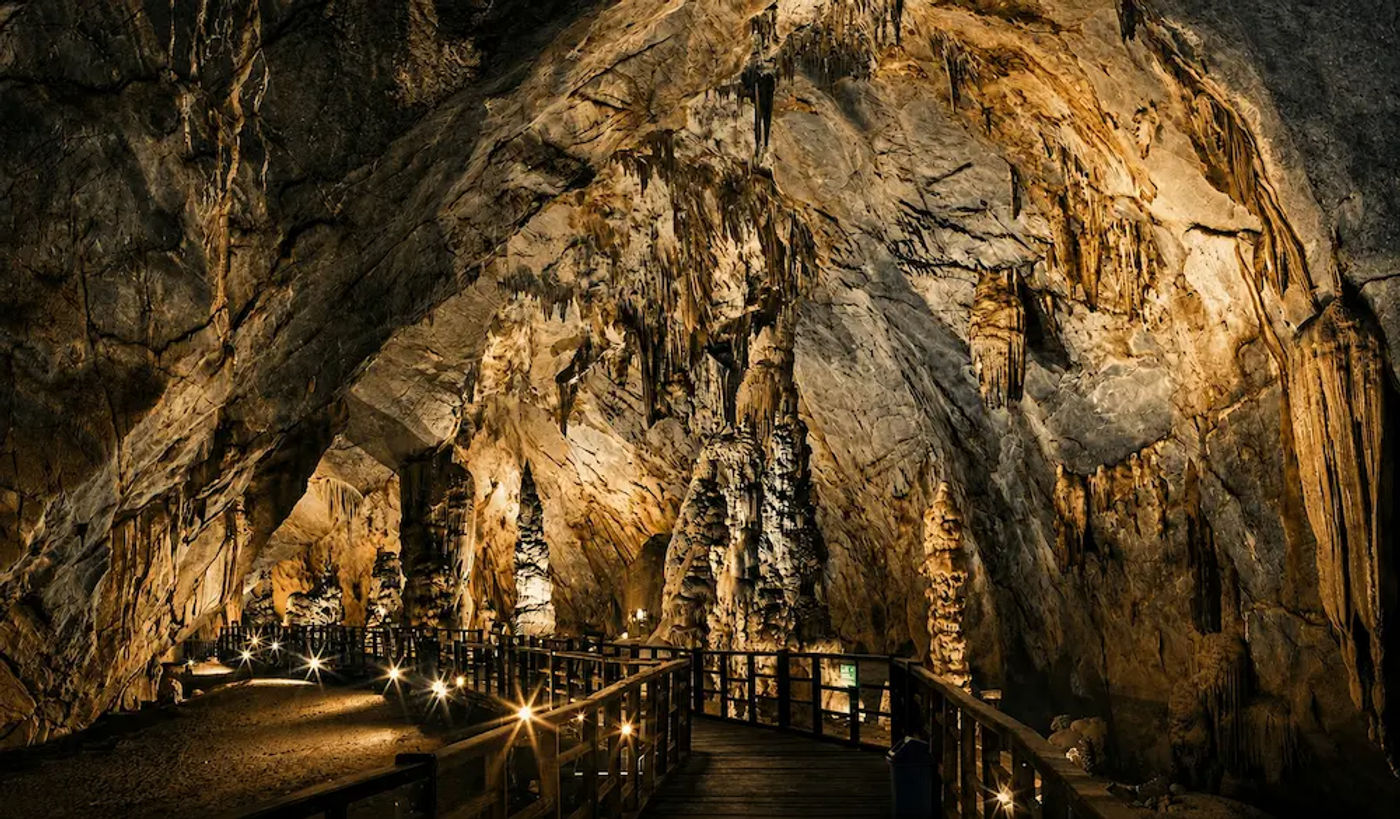
Nguom Ngao is a limestone cave system 3 km from Ban Gioc Waterfall, estimated at 400 million years old. Three entrances, Nguom Ngao, Nguom Lom, and Ban Thuon, connect a main passage around 2.5 km long. The cave is electrically lit along the visitor route and walkable without specialist equipment. The stalactite formations are large and well-preserved. Entry costs 40,000 VND. Allow 45 to 60 minutes for the standard route. Internal temperature stays around 18 to 20°C year round, making it a cooler option on hot summer days.
Khuoi Ky Ancient Stone Village
Khuoi Ky is a Tay ethnic village built entirely from locally quarried stone, with the oldest structures over 400 years old. Fourteen households remain, most of which still use traditional stone construction methods. It sits 3 km from Ban Gioc and is accessible by a short paved road. There is no entry fee. The village is not a reconstructed attraction, families live and work here, which is both its appeal and a reason to move through respectfully. A local homestay operates in the village for riders who want to stay overnight rather than returning to Ban Gioc.
Thang Hen Lake
Thang Hen sits at one of the higher elevations in Cao Bang province, on a limestone plateau above Tra Linh district. The lake covers roughly 3.5 hectares and maintains a jade-green colour year round from the limestone minerals in the surrounding rock. The plateau road approaching the lake passes through a series of smaller ponds and forest, making the ride as worthwhile as the destination. There is no formal entry fee, though local caretakers manage the access track. Morning visits give the clearest water colour; afternoon can bring haze from the valley below.
Mat Than Mountain
Mat Than, known locally as Phja Piot, translates roughly as “mountain with a hole,” a natural circular opening in the limestone face visible from the road below. It sits about 30 km from Cao Bang city near the Thang Hen area and is accessible via a short trail from a roadside parking point. The hike to the viewpoint takes around 40 minutes. The surrounding valley and Thang Hen Lake are visible from the top on clear days. There is no formal infrastructure at the trailhead; ask locally for the most recent access point before you set off.
What to Eat in Cao Bang
Cao Bang has a distinct food culture shaped by the Tay, Nung and Dao ethnic communities. These are dishes specific to the province and worth eating here rather than in Hanoi.
Cao Bang rice rolls (banh cuon Cao Bang) are made and served differently from the Hanoi version. Instead of fish sauce, they come with a pork bone broth alongside Mac Mat leaves, chilli and pickled bamboo shoots. Eaten for breakfast or as a mid-morning stop in Trung Khanh or Cao Bang city.
Sour pho (pho chua) is the most distinctive bowl in the province. The broth is replaced with a vinegar-based sauce, served cold over chewy rice noodles with crispy pork belly, roasted duck, fried sweet potato and fresh herbs. Found in most local restaurants in Cao Bang city and along the route to Trung Khanh.
Seven-spice roast duck (vit quay 7 vi) is marinated with seven spices and slow-roasted. The skin is crackled, the meat is tender and the flavour is noticeably different from standard roast duck elsewhere in Vietnam. Order it whole or by portion in Cao Bang city.
Trung Khanh chestnuts grow in the forest around Trung Khanh district and are in season from September to November. They are sold roasted by the roadside on the approach to Ban Gioc and have a richer, sweeter flavour than Chinese or European varieties. Worth buying a bag for the road.
Ant egg cake (banh trung kien) is made by the Tay community using glutinous rice flour and ant eggs harvested in April and May. The eggs are sautéed with pork fat and wrapped in ve leaves. The flavour is mild and slightly nutty. Only available fresh in spring and from a handful of market stalls, so ask locally where to find it.
How Much Does a Cao Bang Motorbike Tour Cost?
Costs split into two categories: guided tours with IRTouring, and self-riding independently. Here is a realistic 2026 breakdown for each.
Guided tour with IRTouring: IRTouring runs Cao Bang as part of its northeast Vietnam circuit, combining it with Ha Giang and Ba Be depending on itinerary length. Guided departures include accommodation, most meals, a support vehicle, guide fees and fuel logistics. Contact IRTouring directly for current pricing by group size and route.
Bike rental (self-ride): Semi-automatic 110 to 125 cc bikes rent for 150,000 to 200,000 VND per day from Hanoi. Adventure bikes in the 150 to 250 cc range run 350,000 to 600,000 VND per day. Factor in an extra deposit of 2,000,000 to 5,000,000 VND, refundable on return.
Accommodation: Guesthouses in Cao Bang city cost 200,000 to 350,000 VND per night. Homestays near Ban Gioc run 150,000 to 300,000 VND including dinner and breakfast. The few mid-range options near the waterfall charge up to 800,000 VND. Book Ban Gioc accommodation directly by phone rather than through booking platforms, which add 15 to 20%.
Food: Eating at local restaurants and market stalls costs 50,000 to 80,000 VND per meal. A full day of food including drinks sits around 200,000 to 250,000 VND per person.
Entry fees: Ban Gioc Waterfall 45,000 VND. Nguom Ngao Cave 40,000 VND. Pac Bo Cave 15,000 VND. Thang Hen Lake is free. Budget around 100,000 to 150,000 VND total for entrance fees across the circuit.
Fuel: The full four-day loop covers approximately 600 km. At current petrol prices, fuel costs around 200,000 to 250,000 VND for a 125 cc bike and 300,000 to 400,000 VND for a larger adventure bike.
A realistic four-day self-ride budget excluding bike rental is around 1,500,000 to 2,000,000 VND per person.
What to Pack for a Cao Bang Motorbike Tour
Riding Gear
A full-face or at minimum open-face helmet with chin protection is essential for the passes. The road surface on Ma Phuc and Ngoc Khe is rough in sections and visibility through cloud is low in the morning. Gloves, a riding jacket and eye protection are the baseline. IRTouring provides helmets with rental bikes on guided departures; if you own your own gear, bring it.
Clothing
Pack for a 10 to 15°C temperature range within a single day. Mornings on the passes are cold even in September. A lightweight down jacket that compresses small and a waterproof shell are more useful than a heavy riding jacket alone. Long trousers and closed-toe shoes with grip are necessary for the cave walk and the Mat Than trail. Villages in Cao Bang are conservative; cover up when walking through.
Navigation
Mobile data signal is reliable on Highway 3 and in Cao Bang city but drops out between Pac Bo and Ban Gioc along the pass road. Download offline maps of Cao Bang province before leaving the city. Mark Pac Bo, the Ma Phuc Pass summit, Ban Gioc, and Khuoi Ky as waypoints. The turnoffs are unsigned and easy to miss. A handlebar phone mount is more practical than holding the phone.
Health and Practical Items
Sunscreen is necessary on the plateau above Tra Linh where there is no tree cover. Insect repellent matters on the forest trail to Mat Than and around the Pac Bo stream. Carry at least two litres of water. Fuel stations are sparse between Pac Bo and Ban Gioc, and the same applies to shops. A basic first aid kit and any personal medication. Cao Bang is a border province; carry your passport, visa and driving licence at all times. Police checkpoints appear on Highway 3 and on the road approaching Trung Khanh.
Practical Notes for Riding Cao Bang
Road conditions on Highway 3 between Hanoi and Cao Bang city are good, dual carriageway for much of the Thai Nguyen section and well-maintained single lane through Bac Kan. The mountain roads north of Cao Bang city are narrower and paved but uneven in places. The worst surface on the standard circuit is the access track to Nguom Ngao Cave, which is loose gravel for around 1 km.
Fuel stations are plentiful between Hanoi and Cao Bang city. North of Cao Bang, fill up in the city before heading to Pac Bo. There is a station in Trung Khanh town and one near Ban Gioc village. Do not count on finding fuel between these points.
Cao Bang is a border region. Police checkpoints are more frequent than in the interior provinces and documentation checks are routine, not targeted. Carry originals of your passport, visa and driving licence, not photocopies. If riding on a guided tour with IRTouring, the guide will advise on checkpoint protocol.
Mobile coverage on Viettel and Mobifone is reliable in Cao Bang city and along Highway 3. Coverage drops between Pac Bo and Ban Gioc along the mountain road. Download maps and share your itinerary with someone before riding the northern section. IRTouring guides carry satellite communication on remote-route departures.
The passes north of Cao Bang city, Ma Phuc, Khau Lien and Ngoc Khe, are steep on both sides and have tight blind corners. Trucks use these roads, especially in the morning. Ride on your side of the centre line and do not overtake on switchbacks.
Frequently Asked Questions
How do I get from Hanoi to Cao Bang by motorbike?
The standard route is Highway 3 north through Thai Nguyen and Bac Kan to Cao Bang city, covering 270 km. Riding time is five to six hours with one fuel and food stop. An alternative route via Bac Son adds around 40 km but passes through the Bac Son karst valley, which is worth the detour if you have time. Highway 3 is the more direct option and the one most guided tours use for the outbound leg.
Can I combine a Cao Bang motorbike tour with Ha Giang?
Yes, and it is a natural pairing. From Ban Gioc, the road west via Bao Lac connects directly to Meo Vac and the Ha Giang loop. This route is around 180 km and involves serious mountain riding on remote roads. IRTouring runs a combined northeast circuit that covers Ha Giang, Cao Bang and Ba Be National Park in a single itinerary of seven to fourteen days depending on the route selected.
What riding experience is needed for the Cao Bang circuit?
The main circuit, Hanoi to Cao Bang city to Ban Gioc and back, suits riders with basic mountain road experience. The Ma Phuc Pass involves tight switchbacks and some exposure but is not technical. The route connecting Cao Bang to Ha Giang via Bao Lac is a different proposition: remote, long days, rough in sections, and suitable for intermediate to experienced riders only. Contact IRTouring with your experience level and they will match you to the right itinerary.
Is it worth hiring a guide for Cao Bang?
For the main Hanoi to Ban Gioc circuit on a well-maintained bike with offline maps, self-riding is manageable. The roads are signed well enough in the settled areas. The arguments for riding with an IRTouring guide are practical: the route connecting to Ha Giang via Bao Lac is remote enough that a support vehicle matters; checkpoint navigation in the border area is easier with a guide; and accommodation near Ban Gioc books out during October without someone who knows the local options. For first-time riders in the northeast, a guided departure removes enough uncertainty to make the riding itself more enjoyable.
What is the road like from Ban Gioc to Ha Giang?
The road from Ban Gioc to Meo Vac via Bao Lac covers approximately 180 km and takes six to eight hours of riding. The first section through Trung Khanh and down to the Bao Lac valley is paved but steep and winding. The approach to Meo Vac from Bao Lac follows the Ma Pi Leng Pass area on roads that are paved but narrow, with significant elevation change. This section requires an intermediate skill level at minimum and is not suitable for semi-automatic 110 cc bikes. IRTouring uses adventure bikes on this connector for good reason.
Bottom Line
Cao Bang is the least visited and least packaged of Vietnam’s major motorcycle destinations, and that is currently its strongest quality. The roads between the passes and Ban Gioc are quiet enough that you can stop anywhere without causing a traffic problem, and the stops themselves, Pac Bo, Nguom Ngao Cave, Khuoi Ky, are not yet managed to the point where the original character has been replaced by souvenir infrastructure.
The window for riding it in that condition is probably finite. September and October remain the best months: dry roads, golden rice fields, temperatures that work in a riding jacket. The food in Cao Bang is genuinely distinctive and worth planning meals around rather than treating as an afterthought.
IRTouring runs guided departures on the Cao Bang circuit as standalone tours and as part of longer northeast loops combining Ha Giang and Ba Be. Contact them directly to discuss dates, route length and which sections of the northeast matter most to your riding plan.
About the Author
Hamid is a rider and tour guide based in Hanoi, specialising in motorcycle tours across northern Vietnam. He has led international riders through Ha Giang, Cao Bang and the northeast circuit for over a decade and runs adventure departures with IRTouring.