Northeast Vietnam Motorbike Tour — Cao Bang, Ba Be, and the Roads Nobody Rides

The northeast corner of Vietnam is the least-ridden region in the north. Riders who have done Ha Giang, the northwest, and the Ho Chi Minh Trail and are looking for somewhere genuinely different end up here eventually. Cao Bang province sits against the Chinese border with a landscape of karst peaks, wide river valleys, and a waterfall on the frontier that most international visitors have never heard of.

Ba Be Lake sits inside a national park in Bac Kan province on a road that sees almost no touring traffic. Lang Son guards the main overland route into China through a mountain pass used by traders for a thousand years. The backroads connecting all of it carry the kind of riding that disappears the moment a place gets discovered. This is the window before that happens.

Why the Northeast Gets Skipped and Why That Works in Your Favour

The northwest has the famous passes. Ha Giang has the karst plateau and the Instagram viewpoints. The northeast has neither of those things working for or against it. What it has is space, quiet roads, a border landscape that carries serious history, and a concentration of natural and cultural destinations packed into a compact riding circuit that can be completed in five to eight days from Hanoi.

The roads here are genuinely less travelled. Provincial routes in Cao Bang and Bac Kan carry local traffic trucks heading to the Chinese border, farm vehicles, motorbikes loaded with produce,  but almost no touring motorcycles outside of the occasional independent rider who stumbled onto the route by accident. Group tours rarely come here. The guesthouses are local. The markets are for the communities around them rather than visitors passing through. That is not a disadvantage. That is the point.

The Destinations

Cao Bang

Cao Bang city sits at 244 meters in a wide river valley where the Bang Giang and Hien rivers meet, surrounded on every side by karst peaks that rise abruptly from the valley floor.

The city itself is a functional provincial centre, good food, a busy market, straightforward guesthouses, and none of the tourist infrastructure that has altered the character of more visited towns in the north. Cao Bang is the hub of the northeast circuit.

Most routes in the region start or pass through it, and the roads radiating out from the city cover the full range of what the northeast offers sealed valley routes to the Chinese border, mountain passes north toward Ban Gioc, and the backroad circuit south toward Bac Kan and Ba Be.

Ban Gioc Waterfall

Ban Gioc sits on the Vietnamese-Chinese border in Dam Thuy commune, 90 kilometers northeast of Cao Bang city. It is the largest waterfall in Southeast Asia outside the Mekong system, a wide curtain of water dropping across a tiered stone shelf into a pool shared between Vietnam and China.

The falls run at their most powerful from June through September when the upstream rivers are full, but they carry significant volume year-round. The road from Cao Bang to Ban Gioc runs through the Trung Khanh district on a sealed provincial route through karst forest and river valley light traffic, good surface, the kind of riding that makes the destination feel earned rather than delivered.
The Chinese side of the falls is visible from the Vietnamese bank.

On busy weekends bamboo rafts operate on the Chinese portion of the pool. The Vietnamese side has a park area and a viewing embankment. Early morning visits before the day-trip buses arrive from Cao Bang give you the falls in quiet. The guide times the approach accordingly.

Nguom Ngao Cave

Three kilometers from Ban Gioc, Nguom Ngao translates from the Tay language as Tiger Cave. The cave system extends for 2,144 meters through the karst beneath the border hills, with three entrances and a series of large chambers containing active stalactite and stalagmite formations.

The sections open to visitors cover around 900 meters of the total system. The cave floor is a developed walking path with lighting, an hour to walk through at a reasonable pace. The temperature inside holds at around 17 degrees regardless of external conditions, which after a morning of riding in Cao Bang heat is reason enough to stop.

God’s Eye Mountain — Mat Than

God’s Eye Mountain, known locally as Mat Than, is a karst peak northeast of Cao Bang city with a natural circular opening near its summit that frames a view of the valley below when looked at from the right angle. The road to the base of the mountain runs through Quang Uyen district on a quiet provincial route.

The surrounding landscape, flat paddy valley ringed by karst peaks, is one of the better riding settings in the northeast, where the road runs straight through the valley floor with the mountains framing every direction. Not a major attraction by conventional measures but a genuine highlight on the riding route for what it represents: the kind of place a guided tour finds that a map app does not suggest.

Thang Hen Lake

Thang Hen is a system of 36 interconnected lakes sitting at 600 meters elevation in Tra Linh district, Cao Bang province. The lakes are connected by underground channels through the karst and their water levels shift with the seasons, in dry season some of the smaller lakes shrink to marsh; in wet season the whole system swells and the reflections of the surrounding peaks on the water surface are the best views in the northeast.

The road to Thang Hen from Cao Bang city climbs through karst forest on a sealed route that narrows to a single track on the final approach. The lake sits in a bowl with no commercial development, a picnic area and a boat rental, nothing more.

Quang Uyen

Quang Uyen is a market town in the district of the same name between Cao Bang city and the Ban Gioc road. The weekly market here draws Tay, Nung, and Hmong traders from across the surrounding border highlands. The town sits in a flat valley ringed by karst with a river running through the centre.

The roads around Quang Uyen connect to a series of backroad loops through the district, laterite tracks between Tay stilt-house villages, karst forest paths, and the stone road north toward the Chinese border that carries border-trade traffic on market days. Quang Uyen works well as a lunch stop on the Ban Gioc run and as the starting point for the district backroad loop on the full northeast circuit.

That Khe

That Khe is a border town in Lang Son province sitting in the valley of the Ky Cung River, 33 kilometers north of Lang Son city on the road toward the Friendship Pass. The town has a character that border trade towns across Southeast Asia share, a mixture of Vietnamese and Chinese goods in the market, languages overlapping at the stalls, and a general atmosphere of commerce that does not particularly care about tourism.

The road from Cao Bang to That Khe via the mountain pass north of Nguyen Binh is one of the best stretches of riding on the northeast circuit, a sealed mountain route carrying almost nothing except local traffic through dense forest above 800 meters.

Lang Son

Lang Son city sits 155 kilometers northeast of Hanoi at the southern end of the Friendship Pass corridor, the main overland route between Vietnam and China that has carried trade, armies, and refugees in both directions for over a thousand years.

The Ky Lua market in the old quarter trades in Chinese goods crossing the border 18 kilometers north at Dong Dang. The Tam Thanh and Nhi Thanh caves in the karst hills above the city contain 18th century Vietnamese poetry carved into the cave walls by scholars who used the caves as retreats. The road from Lang Son south to Hanoi is fast and direct, the final leg of the northeast circuit before the return to the city.

Bac Kan and Ba Be National Park

Bac Kan province sits south of Cao Bang and carries none of its neighbour’s border drama, it is quieter, greener, lower in elevation, and almost entirely unknown to international visitors.

Ba Be National Park covers 23,340 hectares of primary forest, karst hills, and wetland around Ba Be Lake. The park is listed as a Ramsar wetland site of international importance and holds one of the most biodiverse forest ecosystems remaining in northern Vietnam.

The road into the park from Bac Kan city runs through the park buffer zone on a narrow sealed route alongside the Nang River, the kind of road where you slow down not because of the surface but because stopping every few kilometers to look at something is unavoidable.

Ba Be Lake

Ba Be Lake is Vietnam’s largest natural freshwater lake, sitting at 145 meters elevation inside the national park. The lake is actually three connected bodies of water, Ba Be means Three Lakes in Vietnamese, covering 500 hectares and reaching depths of 35 meters in the central section.

The surrounding forest comes down to the waterline on most of the shoreline, with limestone cliffs rising directly from the water on the eastern edge. Tay stilt-house villages sit on the western and northern banks, Pac Ngoi village is the main homestay community and the departure point for boat trips on the lake.

The boat ride on Ba Be is not an optional add-on. It is a genuine part of the northeast circuit that changes the perspective completely after days of motorcycle riding. The Dau Dang waterfall at the northern end of the lake system is accessible only by boat. The Puong Cave, a river cave with a bat colony estimated at several hundred thousand animals, runs through a karst outcrop on the lake’s eastern edge and the boat passes through it on the standard circuit. Mornings on the lake before the mist burns off are the quietest hour of the whole trip.

Offroad, Backroads, and Dirt Tracks in the Northeast

The northeast does not have the dramatic single-track offroad sections of northern Laos or the steep technical climbing of Ta Xua in the northwest. What it has is a network of backroad and secondary routes through the border highlands that carry almost no traffic and cover terrain that sealed highway touring misses entirely.

These are the sections that define the guided northeast circuit and separate it from a point-to-point tour connecting the main attractions.

The Quang Uyen District Backroads

The district roads north and east of Quang Uyen town run through a Tay and Nung farming landscape of paddy valley, karst forest, and border-trade tracks. The surface alternates between patchy sealed road and compacted laterite depending on which district authority last maintained the section.

The route loops through several Tay stilt-house villages before connecting back to the main Ban Gioc road north of Trung Khanh. Light traffic, manageable surfaces, and the kind of riding pace that allows genuine stops in villages without a schedule pulling the group forward.

The Cao Bang to That Khe Mountain Pass Road

The road from Cao Bang southwest through Nguyen Binh to That Khe climbs through the Phia Oac mountain range, a forest-covered massif that separates the Cao Bang basin from the Lang Son corridor.

The sealed road crosses the range at around 800 meters through dense primary forest that has survived intact largely because the pass road is too narrow for logging trucks. The descent toward That Khe runs alongside the Ky Cung River through Tay villages that farm the narrow valley floor between the forest edge and the river bank. This section carries almost no touring traffic and the forest road above Nguyen Binh is the most scenically consistent stretch of sealed riding on the entire northeast circuit.

Ba Be National Park Internal Tracks

Inside the national park boundary, a network of unpaved tracks connects the lakeside villages and runs into the forest buffer zone. These are not official tourist routes, they are the paths the Tay farming communities use to reach their fields and the forest gathering areas beyond the village boundary.

The guide knows which tracks are accessible by motorcycle and which are walking paths only. The track from Pac Ngoi village north along the lakeshore to the small fishing community at Bun Lom is a good example, laterite surface, tree cover, the lake visible through the forest on one side. Not technical riding. Good riding.

The Lang Son Backroad via Dong Mo

The standard road from Lang Son to Hanoi on Highway 1A is fast, busy with truck traffic, and holds nothing of interest beyond the distance it covers.

The backroad variant via Dong Mo and Huu Lung takes longer and covers similar distance on provincial roads through low karst hills and valley farming communities south of Lang Son. The surface is sealed but narrow and the traffic drops to almost nothing once the highway is left behind.

This is the final riding day of the northeast circuit and the backroad finish is consistently preferred by riders who have spent the previous days on quiet provincial routes and have no interest in ending the trip on a truck highway.

The Route — Day by Day

This is the 8-day full loop ride. The 5-day version covers Cao Bang, Ban Gioc, That Khe, and Lang Son without the Ba Be section.

Day 1 — Hanoi to Bac Kan via Thai Nguyen

Leave Hanoi northeast through Thai Nguyen province on a route that clears the city traffic within an hour and climbs into the low karst foothills of Bac Kan province by mid-morning. Thai Nguyen is Vietnam’s tea capital, the roadside stalls selling fresh green tea leaves start appearing about 80 kilometers north of Hanoi and continue through the province.

Bac Kan city by early afternoon, time to ride the river road south of town before dinner. Approximately 170 kilometers, 3 to 4 hours.

Day 2 — Bac Kan to Ba Be Lake

North from Bac Kan city into the national park on the Nang River road. The road narrows as it enters the park buffer zone and the forest closes in on both sides. Ba Be Lake reached by late morning. Afternoon boat trip on the lake — Dau Dang waterfall, Puong Cave, the northern lakeshore communities.

Overnight in a Tay stilt-house homestay in Pac Ngoi village on the lakeshore. Approximately 60 kilometers riding, most of the day on the water and the park tracks. Approximately 60 kilometers, 2 hours riding.

Day 3 — Ba Be to Cao Bang via the Forest Road

The road north from Ba Be to Cao Bang climbs out of the national park through the Bac Kan highlands on a route that connects the park’s northern boundary to the Cao Bang basin via a series of passes through forest that thickens as the elevation rises.

The surface is sealed but narrow and the traffic is light enough that the guide sets a relaxed pace through the best sections. Cao Bang city by early afternoon. Time to walk the market and eat well before the border roads begin the next morning. Approximately 130 kilometers, 3 to 4 hours.

Day 4 — Cao Bang — Thang Hen Lake and God’s Eye Mountain

A day on the roads around Cao Bang rather than a transit day. Morning ride northeast to Thang Hen lake system in Tra Linh district, the climb to the lake plateau on the narrow sealed track, time at the lake, and the return via the valley road through Tay villages below the karst.

Afternoon ride south through Quang Uyen district to God’s Eye Mountain at Mat Than, arriving at the viewpoint angle in the afternoon light when the circular opening in the peak is most clearly defined. Return to Cao Bang for overnight. Approximately 120 kilometers of guided riding.

Day 5 — Cao Bang to Ban Gioc via Quang Uyen Backroads

Rather than the direct highway to Ban Gioc, the guided route takes the Quang Uyen district backroads north through Tay and Nung villages before rejoining the main road at Trung Khanh for the final approach to the falls.

The backroad section adds an hour to the journey and covers the laterite district tracks through the border farming landscape that the main road bypasses. Ban Gioc waterfall by late morning, Nguom Ngao cave in the early afternoon. Return to Cao Bang or overnight in Trung Khanh. Approximately 180 kilometers, 5 hours including stops.

Day 6 — Cao Bang to That Khe via Nguyen Binh

West from Cao Bang through Nguyen Binh on the mountain pass road through the Phia Oac range. The forest road above 600 meters is the highlight of this day, dense canopy, sealed surface, almost no traffic, the Ky Cung River appearing in the valley below as the descent begins toward That Khe.

That Khe by mid-afternoon. The border market in town is worth an hour of walking before dinner. Overnight That Khe. Approximately 110 kilometers, 3 to 4 hours.

Day 7 — That Khe to Lang Son

South from That Khe along the Ky Cung River valley to Lang Son city. The river road is flat and follows the water through Tay farming communities for most of its length. Lang Son by late morning. Afternoon covers the Ky Lua market, the Tam Thanh and Nhi Thanh caves above the city, and the road north toward Dong Dang and the Friendship Pass — the Chinese border gate visible from the Vietnamese checkpoint 2 kilometers south. Overnight Lang Son. Approximately 80 kilometers, 2 hours riding.

Day 8 — Lang Son to Hanoi via Dong Mo Backroad

The backroad finish. South from Lang Son on the Dong Mo provincial route through Huu Lung district rather than the Highway 1A truck corridor. Low karst hills, valley rice paddies, light traffic, and a sealed surface that runs comfortably at touring pace all the way to the Hanoi approach road. City by early afternoon. Approximately 170 kilometers, 4 hours.

Route Overview

  • Duration: 5 days (Cao Bang and border circuit) or 8 days (full northeast including Ba Be)
  • Total distance: 750 km (5-day) to 950 km (8-day)
  • Daily average: 60 to 180 kilometers depending on day
  • Terrain: sealed mountain road, provincial backroad, laterite district tracks, national park internal paths
  • Highest point: Phia Oac pass above Nguyen Binh, approximately 800 meters
  • Start and finish: Hanoi
  • All riding: fully guided with sweep rider

Skill level

Rated: Beginner to intermediate

The northeast circuit is the most accessible of all the northern Vietnam tours in terms of technical demand. The sealed road dominates the distance and the offroad sections, the Quang Uyen backroads, the Ba Be park tracks, the Dong Mo return road, are laterite and compacted earth rather than steep or technical single trail.

Riders new to Vietnam who have multi-day touring experience elsewhere will find the northeast manageable and consistently interesting. The guide manages pace on the pass sections and briefs the group on road conditions each morning before departure.

This tour does not suit complete beginners who have never ridden a manual motorcycle. Riders who are confident on a manual bike and comfortable with basic mountain road riding are in the right range for the northeast circuit.

The bikes

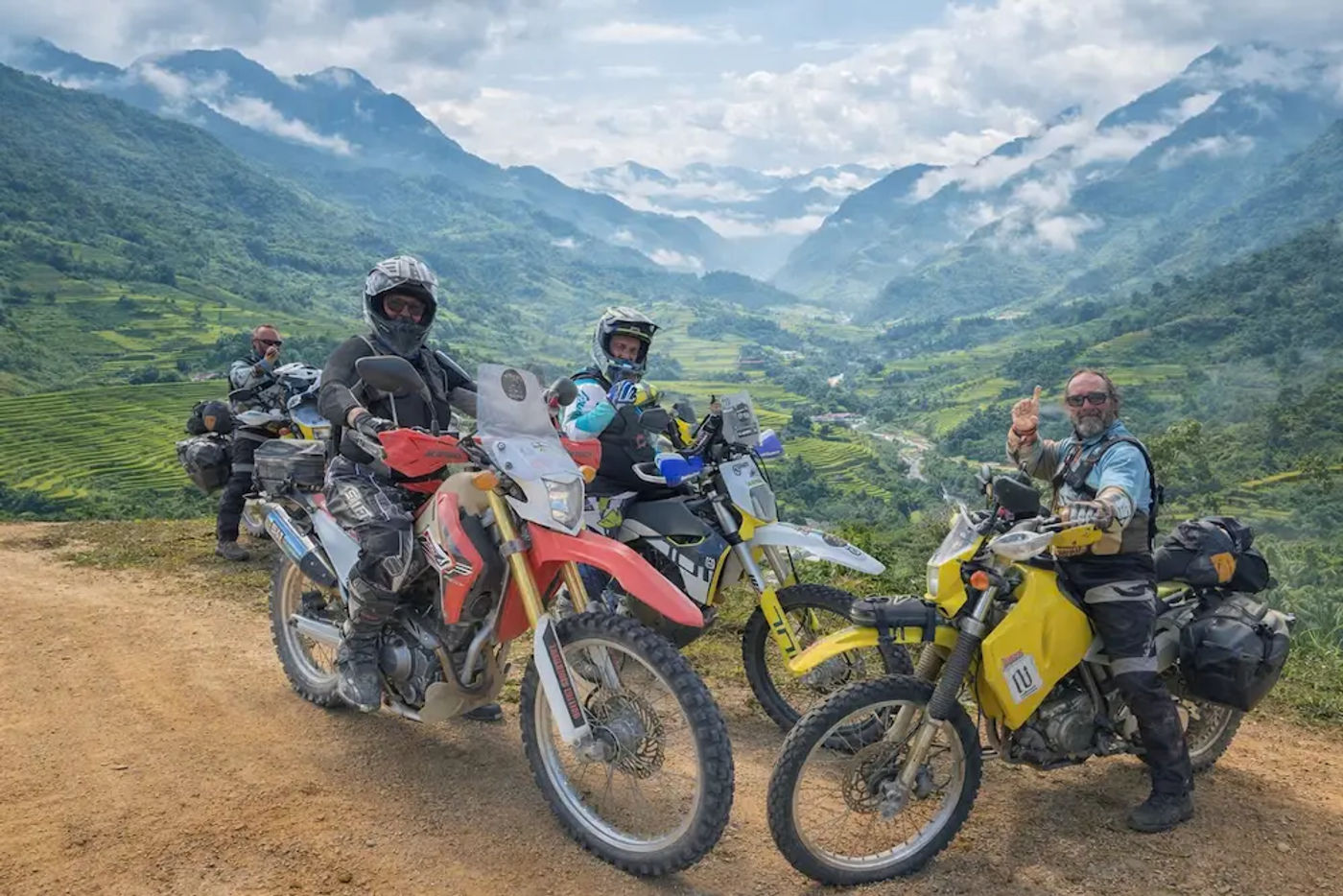
The northeast circuit runs on a range of bikes depending on rider preference and the specific variant chosen.

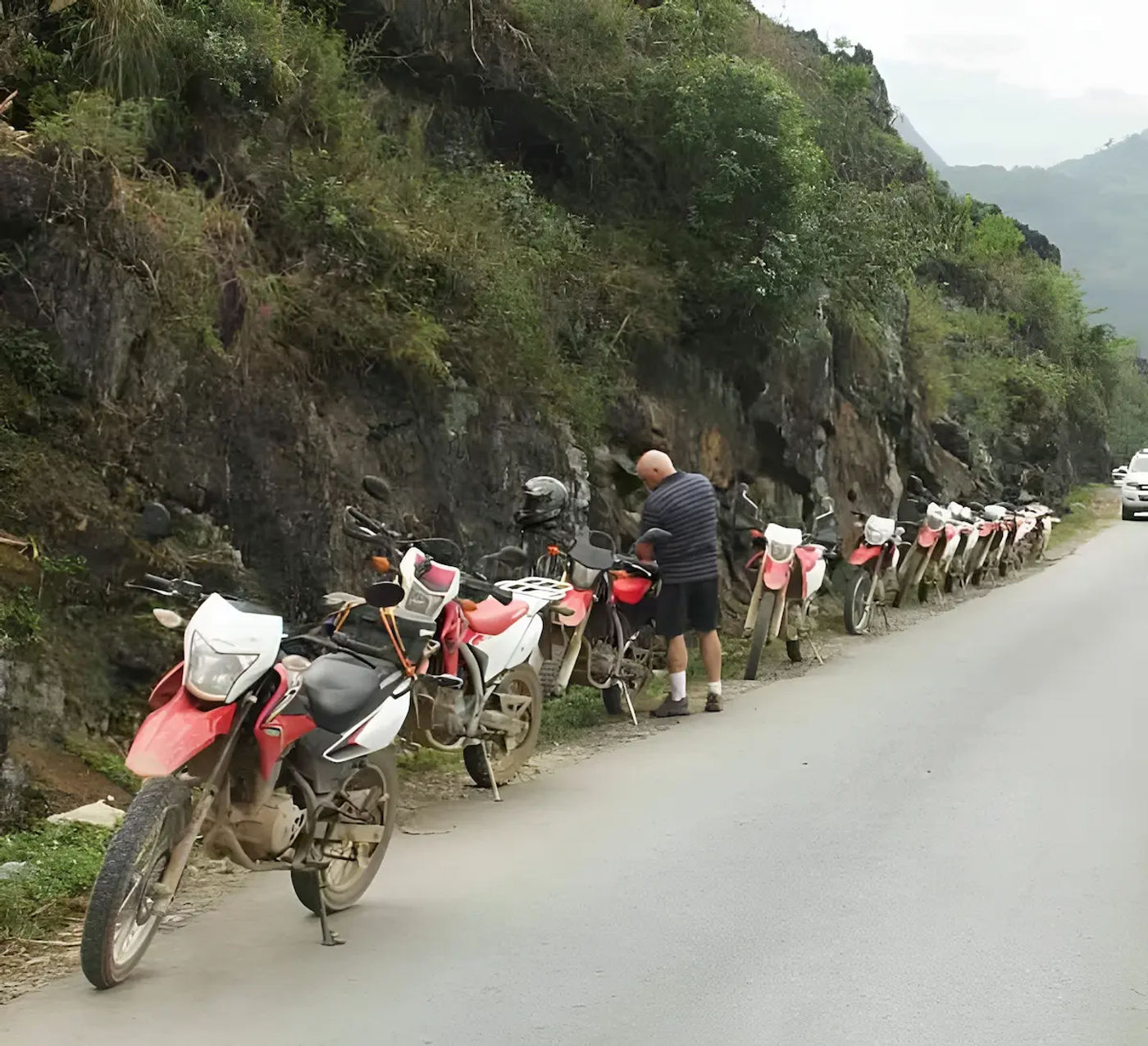
Honda XR 150 suits the sealed road sections and the easier backroads throughout the circuit. Light, easy to manage in village traffic, and sufficient for the gradients and distances involved. The right choice for smaller or lighter riders and for anyone who prefers a nimble bike on narrow provincial roads.

Honda XR 190 steps up the power slightly without adding significant weight. Handles all terrain on the northeast circuit including the Phia Oac pass road and the Ba Be park tracks. A good middle ground for riders who want more confidence on longer daily distances without moving to a heavier adventure bike.

Honda CB500X covers the sealed road sections and the easier backroads comfortably and adds highway stability on the longer transit days between provinces. Heavier than the XR range and better suited to riders with experience managing a larger motorcycle on narrow roads.

The CB500X is not recommended for the rougher laterite tracks in the Ba Be park and the Quang Uyen district backroads.

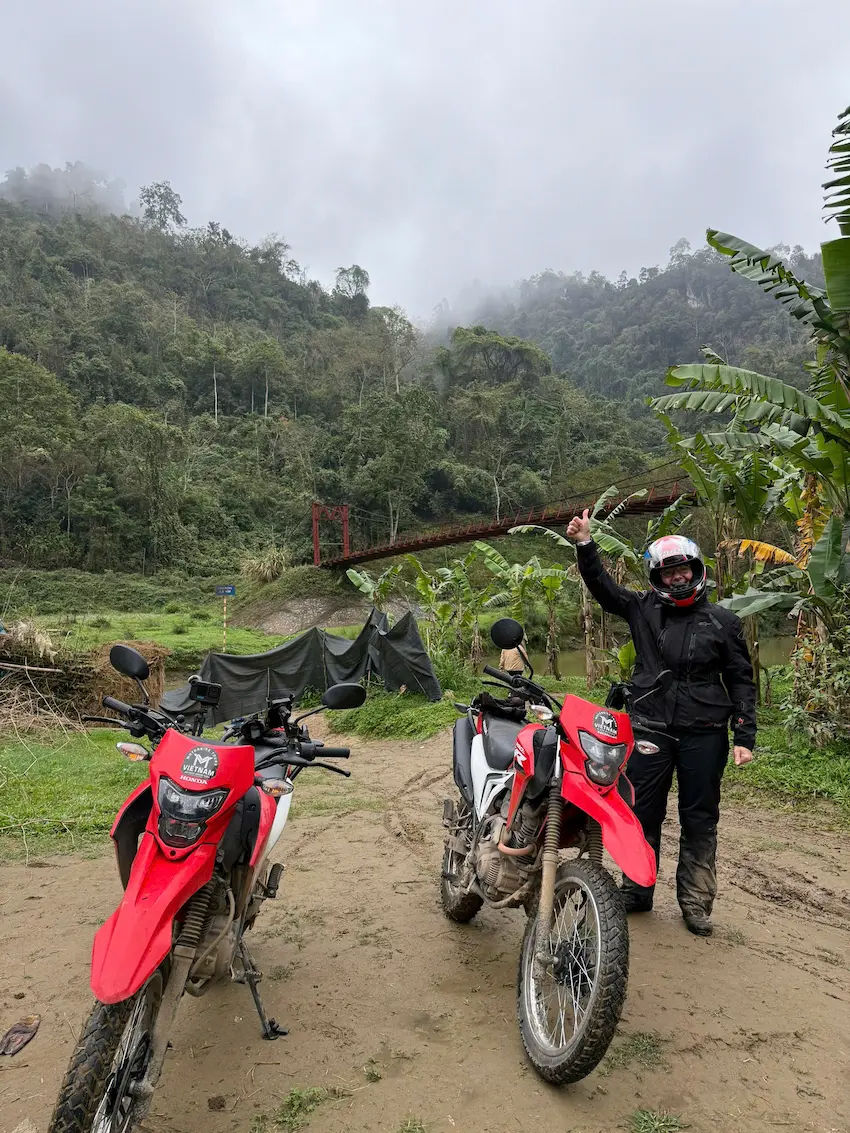
Honda CRF 250L and CRF 300L are available for riders who want the capability to ride every section of the northeast circuit including the rougher park tracks and the steeper district roads without limitation.

The CRF range handles everything on this circuit with room to spare and is the guide’s recommendation for riders doing the full 8-day version with all offroad sections included.

All bikes carry a full toolkit and first aid kit. The sweep rider carries spare levers, cables, filters, and a basic parts kit on every tour.

What’s included

Included: lead guide, sweep rider, motorcycle rental for the full duration, fuel on all riding days, accommodation throughout, breakfast daily, Ba Be National Park entry fees, and the boat trip on Ba Be Lake.

The Ba Be boat trip is included rather than optional because it is a genuine part of understanding what the lake and the park represent, a morning on the water to Dau Dang waterfall and through Puong Cave is not a tourist activity bolted onto a motorcycle tour. It completes the picture of what the northeast holds.

Not included: international flights, Vietnam visa, personal travel insurance with motorcycle coverage, lunches, dinners, and personal expenses on the road.

Travel insurance covering motorcycle riding is mandatory for all riders on this tour.

Best Time to Ride the Northeast

October through April is the reliable window for the full circuit.

In October and November bring clear mountain air, dry roads, and the tail end of the rice harvest in the Ba Be valley and the Cao Bang basin. Temperatures are comfortable at all elevations on the northeast circuit, the highest point on the route sits below 900 meters, so the cold of the Ha Giang plateau in winter does not apply here.

December through February is mild by northern Vietnam standards at these elevations. The mornings are cool rather than cold and the roads are dry. Lang Son province in particular sits low enough that winter temperatures rarely drop below 12 degrees even at night.

March and April are good riding months. The plum and peach orchards above Nguyen Binh on the Phia Oac road flower in late February and the forest road carries blossom through March. Temperatures rising through April make the Ba Be lake mornings warm enough to swim after the boat trip.

May through September brings rain to the northeast from June onward. Ba Be Lake rises significantly in wet season and the boat circuit to Dau Dang waterfall runs through a landscape that is greener and more dramatic than in the dry months. The Puong Cave river level rises and the bat colony activity increases. The tradeoff is wetter roads and reduced visibility on the pass sections. The sealed circuit is rideable in wet season.

The laterite backroad sections require more caution and some tracks may be impassable after heavy rain.

Frequently Asked Questions

What is the boat trip on Ba Be Lake like?

The waterfall itself is exceptional. The road to it, 90 kilometers of karst valley riding from Cao Bang on a quiet provincial route,  is worth the trip independently of the destination.

Riders who approach it as a single attraction to tick off a list and turn around miss the point. The northeast circuit builds the Ban Gioc road into a two-day section that covers Thang Hen, God’s Eye Mountain, and the Quang Uyen backroads on the approach and Nguom Ngao cave on the day of the falls.

The distance from Hanoi, approximately 400 kilometers to Cao Bang, is covered in stages over two days, not as a single push.

Is Ban Gioc Waterfall worth the distance from Hanoi?

The standard guided boat circuit on Ba Be covers the main lake body, the channel north to Dau Dang waterfall, and the passage through Puong Cave. The Tay boatmen who operate the wooden longboats on the lake have been running this circuit for decades. The cave passage is low in places, sitting passengers crouch as the boat moves through.

The bat colony in Puong Cave numbers in the hundreds of thousands and the sound and movement as the boat passes through is significant. Allow three to four hours for the full circuit. Morning departures catch the mist on the lake before it clears.

How does the northeast circuit differ from the North Vietnam Circuit?

The North Vietnam Circuit covers Ha Giang, Cao Bang, and Ba Be as part of a longer loop that also includes the northwest highlands, Son La, Dien Bien Phu, Sapa, and Mu Cang Chai.

The northeast circuit focuses exclusively on the Cao Bang, Lang Son, and Bac Kan region in more depth, covering backroads and destinations that the North Vietnam Circuit skips in the interest of covering more geographic ground. Riders who want to go deep into the northeast rather than across the full north should choose this tour. Riders who want the broadest possible northern circuit should look at the North Vietnam Circuit.

Can the northeast loop be combined with Ha Giang?

Yes. Cao Bang connects to Ha Giang via the Meo Vac road, the same road used on the North Vietnam loop, and the two provinces share the northeast corner of Vietnam’s border with China. Riders who want to combine the northeast circuit with the Ha Giang Loop can do so by extending the itinerary at the Cao Bang end and riding west through Bao Lac and Meo Vac into the Ha Giang plateau.

This adds 3 to 4 days to the northeast circuit and covers the most comprehensive sweep of the northern border region available in a single guided trip. Contact us to build the combined itinerary.

Is there anything to know about the Chinese border areas on this route?

Group departures run October through April. Private tours available year-round. To check availability, ask about combining this route with Ha Giang or the North Vietnam Circuit, contact us directly.

We respond to all inquiries within 12 hours.

Book the Northeast Vietnam Motorbike Tour

The route passes through areas adjacent to the Chinese border at Ban Gioc, That Khe, and the Dong Dang gate near Lang Son. These are all accessible to foreign visitors with a standard Vietnam visa. No additional border zone permit is required for the northeast circuit, unlike the Ha Giang plateau which requires a separate permit for the Dong Van and Lung Cu areas. The guide briefs the group on appropriate behavior at and near border checkpoints before each relevant section.

Scroll to Top