
Vietnam Jungle Motorbike Guide: Best Routes, Trails & Riding Tips for Every Rider
Vietnam’s jungle interior is one of the most demanding and rewarding riding environments in Southeast Asia. The country’s forest cover spans from the fog-wrapped limestone ridges of the northern highlands down to the flat, river-laced wetlands of the Mekong Delta south, and almost every kilometer between them holds a different kind of challenge for riders.
Dense canopy, unpredictable trail surfaces, river crossings with no bridges, and villages reachable only by dirt track, this is the version of Vietnam that most tourists never see. For motorbike riders, it is exactly the point. This guide covers where to go, what trails to expect, when to ride, what gear to carry, and how to handle the conditions that make Vietnam’s jungle riding genuinely unlike anything else on the continent.
- You may check our Ho Chi Minh Trail motorbike ride
Understanding Vietnam’s Jungle Terrain Before You Ride
The Geography That Shapes Every Route
Vietnam stretches more than 1,650 kilometers from north to south, and its jungle terrain is not uniform. The country is divided into three broad riding zones when it comes to jungle and forest environments: the northern highlands, the central range, and the southern lowlands. Each zone has a completely different character in terms of elevation, trail surface, rainfall timing, and the level of technical skill required.
The northern highlands are defined by the Hoang Lien Son and Truong Son mountain ranges. Elevations regularly exceed 1,500 meters, and trails involve extended steep climbs, rocky descents, and rivers that swell dramatically during the wet season.
This is remote territory. Fuel stops can be 60 to 80 kilometers apart, mobile signal drops out for long stretches, and weather can shift from clear to heavy fog in under an hour. The central jungle zone, running through Quang Binh, Thua Thien-Hue, and into the Central Highlands of Dak Lak and Kon Tum, mixes dense tropical forest with wide river valleys and elevated plateaus. Trails here tend to be more varied.
Some sections are well-packed red dirt, others turn to deep mud after rain. The Central Highlands in particular sit at elevations between 500 and 800 meters, which moderates the heat and keeps conditions rideable for more of the year. Southern jungle environments are lowland by nature. The terrain around Cat Tien, U Minh, and Can Gio is flat or gently undulating, with the challenge coming from waterlogged ground, mangrove networks, and thick vegetation that closes in tightly on narrow tracks. These areas suit riders who want jungle immersion without the technical demands of mountain routes.
Trail Surfaces and What to Expect
Vietnam’s jungle trails do not stay consistent. A route that was firm clay in the dry season becomes a sliding surface of red mud in the wet season, and river crossings that were knee-deep in February can be impassable by August. Riders need to understand what the ground beneath them is doing, not just what the map is showing.
The most common surfaces in northern jungle routes are compacted red laterite clay, loose rock on descents, and river gravel at crossings. After rain, laterite clay becomes extremely slippery in a way that catches out riders used to loose gravel. It offers grip until it suddenly does not. In the Central Highlands, black volcanic soil appears in sections and behaves differently again, becoming sticky rather than slippery when wet.
Southern lowland trails are mostly packed earth and gravel on the main tracks, with softer ground appearing the further you ride into wetland zones. Mangrove trails in particular can have sections where the surface is essentially wet sand held together by root systems. It will take a lightweight bike far more easily than a heavy one.
Best Jungle Regions for Motorbike Riders in Vietnam
Pu Luong Nature Reserve – Northern Vietnam’s Most Accessible Jungle Ride
Pu Luong sits in Thanh Hoa Province and occupies a long valley between two parallel limestone ridges. It is one of the few northern jungle destinations where the roads and tracks have a defined character without requiring extreme technical skill. The main valley road follows the Cham River and connects a series of Thai and Muong villages through terraced rice fields and dense forest sections.
The riding that makes Pu Luong interesting for motorbikes is the network of secondary tracks that climb the ridges on either side of the valley. These are narrow, often unpaved, and wind up through forest cover before emerging at viewpoints above the tree line. The descents on the far side of the ridges drop into isolated valley communities that see very few visitors.
For riders, Pu Luong works well as a two to three day loop from Hanoi. The terrain is challenging enough to be engaging but not so exposed that mechanical trouble becomes a serious emergency. Villages are spaced within reasonable distances, locals are accustomed to visitors, and the scenery across the rice terraces and forested ridges rewards steady progress more than speed.
Phong Nha – Ke Bang National Park – Jungle Riding Through a UNESCO Landscape
Phong Nha in Quang Binh Province is internationally recognized for its cave systems, but for motorbike riders, it is equally significant for the jungle trail network that extends west toward the Laos border. The Ho Chi Minh Road, the original wartime supply route, runs through this section of the Truong Son Range and offers one of Vietnam’s most historically layered jungle rides.
The trails heading west from the Phong Nha valley into the national park buffer zone are narrow, forested, and frequently cross streams that have no formal bridges. The jungle here is primary forest in many sections: tall dipterocarp canopy, dense undergrowth, and the kind of silence that only comes from being genuinely far from roads. Riders following the western tracks toward the border will encounter checkpoints, and some areas require permits obtained in advance from local forest management authorities.
The eastern side of the park offers different riding. The roads running south from Phong Nha town through the limestone karst zone are paved but dramatic, with forest walls on both sides and the occasional opening that reveals the full scale of the karst formations above.
- Check out tours that pass this route: 14 days off-road Vietnam dirt bike tour
Yok Don National Park – Dry Deciduous Forest and Open Trail Riding
Yok Don in Dak Lak Province is Vietnam’s largest national park by area and the only one covering a significant expanse of dry deciduous forest. This makes it visually and physically unlike anywhere else in the country. The trees are tall but spaced, the ground is covered in leaf litter rather than undergrowth, and the trails are wide, sandy, and largely open.
For off-road riders, Yok Don offers a specific kind of challenge: deep sand. The trails running through the park’s interior cross sections of loose river sand that demand constant attention and some technical adjustment, including lower tire pressure, steady throttle, and no sudden inputs. The Se San and Serepok rivers run through the park, and crossing points vary from shallow gravel bars to deeper sections requiring wading alongside your bike.
Wildlife density in Yok Don is high. Wild gaur, deer, and a substantial population of wild birds are common sightings on morning rides before the heat builds. The park is one of the few places in Vietnam where encountering large animals on a trail is a genuine possibility rather than a remote hope.
- Check out Vietnam private tours
Cat Tien National Park – Southern Jungle Riding Near Ho Chi Minh City
Cat Tien is the most accessible of Vietnam’s major jungle parks for riders based in or passing through Ho Chi Minh City. It sits roughly 150 kilometers north of the city in a zone where Dong Nai, Lam Dong, and Binh Phuoc Provinces meet. The park covers a mix of wet and dry tropical forest along the Dong Nai River, and the riding within and around it reflects that mixed character.
The approach roads to Cat Tien are paved and fast, but once inside the park boundaries the tracks narrow and the surface changes. Core trails are managed for park vehicles but are open to motorbikes with permits, and they wind through primary forest with river crossings and sections of deep shade where the canopy closes overhead completely.
The Bau Sau trail, a roughly 10-kilometer track leading to the crocodile lake, is the most popular ride within the park, and it gives a clear sense of what southern lowland jungle riding involves: flat, soft ground, high humidity, and the ever-present noise of birds and insects.
Hoang Lien National Park and the Sapa Highlands – High-Altitude Jungle for Experienced Riders
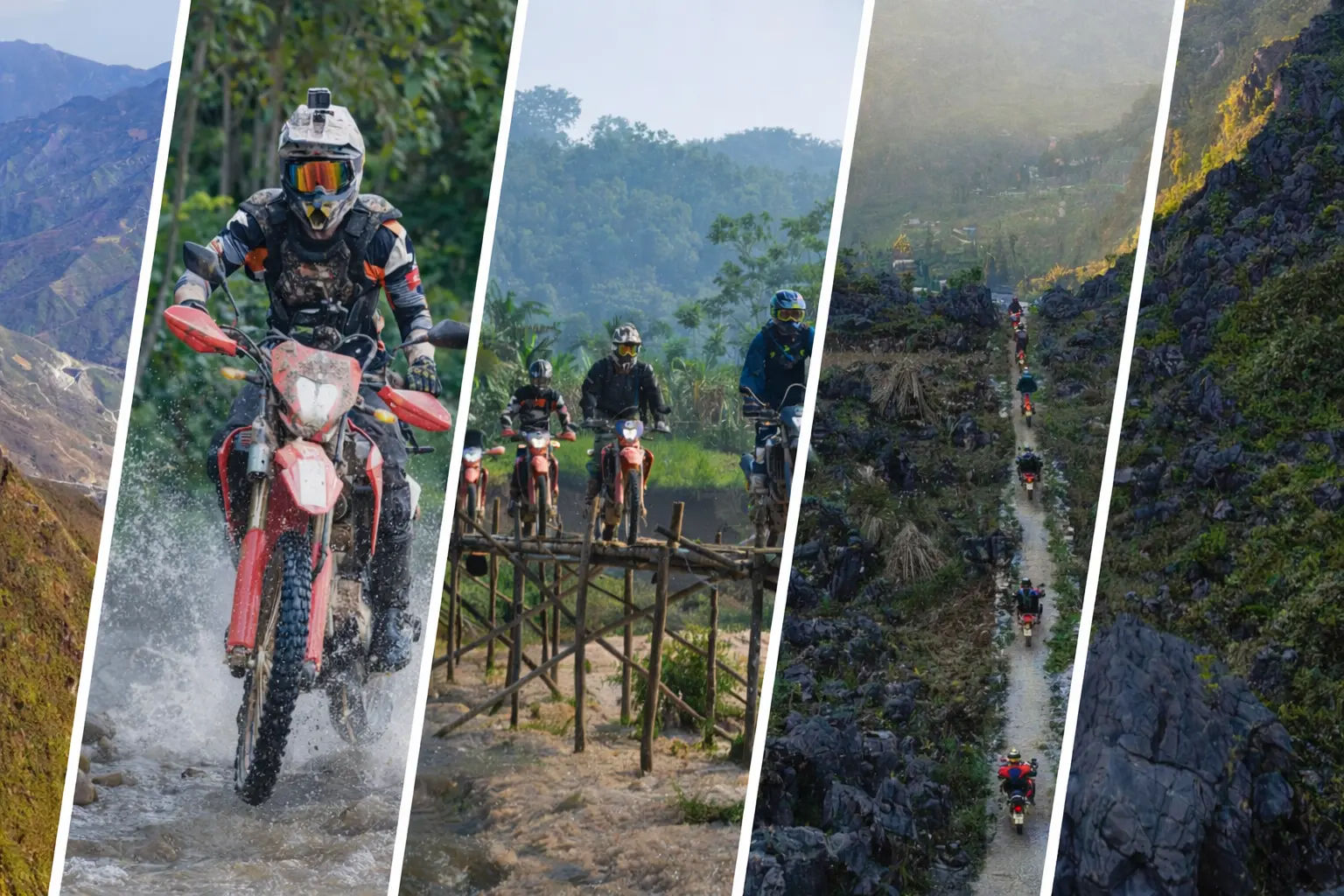
The Hoang Lien range in Lao Cai Province is Vietnam’s most dramatic mountain environment. Fansipan at 3,143 meters is the highest point in the country, and the trails that wind through the national park’s jungle zone at elevations between 1,200 and 2,200 meters are among the most technically demanding in Southeast Asia.
Riding here is not recreational. It is full commitment. Trails drop suddenly, river crossings are cold and fast-moving, mud is deep after any rain, and the fog that settles on the ridges in the afternoon removes visibility almost entirely. The reward is proportional: ancient forest, mossy tree trunks, waterfalls dropping through fern-covered rock faces, and the near-complete absence of other traffic.
The ethnic minority villages, including H’mong, Dao, and Tay communities, that dot the valleys below the park give riders cultural reference points and practical rest stops. These are working agricultural communities, not tourism villages, and the interaction on these routes is genuine in a way that differs from the more-visited trekking trails closer to Sapa town.
Ba Be National Park – Northern Jungle Riding Around a Freshwater Lake
Ba Be in Bac Kan Province is built around Vietnam’s largest natural freshwater lake, surrounded by limestone karst and dense forest. The riding around Ba Be is a combination of paved lakeshore road and secondary tracks that climb into the forested hills surrounding the lake.
The secondary tracks are where Ba Be earns its place on a serious rider’s itinerary. They connect minority Tay villages on the hillsides above the lake, pass through forest sections with no mobile coverage, and involve the kind of riding, loose surface, narrow track, steep gradient, that requires full attention. The lake itself appears through gaps in the forest at intervals, and the contrast between dense jungle interior and open water is one of the more dramatic visual payoffs in northern Vietnam.
- Check out Northeast Vietnam motorbike tours
U Minh Forest – Wetland Jungle Riding in the Far South
U Minh spans Ca Mau and Kien Giang Provinces at the southern tip of Vietnam. It is a completely different environment from anywhere else covered in this guide: a vast peat swamp forest, dark water canals, melaleuca trees standing in flooded ground, and an ecosystem that functions as much on water as on land.
Riding in U Minh means adapting to terrain that changes with water levels. In the dry season, the raised embankment roads through the forest are rideable on almost any bike. In the wet season, sections flood and the riding narrows to elevated paths between canal systems. The forest has a quality unlike highland jungle: low, thick, with filtered light and the constant sound of water. It is demanding in a different way, navigational rather than technical, and disorienting if you stray from marked routes.
Can Gio Mangrove Forest – Day Riding from Ho Chi Minh City
Can Gio sits at the mouth of the Saigon River, roughly 60 kilometers from Ho Chi Minh City’s center, and its mangrove forest is a UNESCO Biosphere Reserve. For city-based riders, it offers a practical half-day or full-day route through a landscape of mangrove channels, monkey islands, and coastal wetland.
The riding in Can Gio is not technical. The roads through the mangrove zone are paved, and the forest tracks are manageable for most bikes. The value here is access: a relatively easy ride that delivers genuine jungle immersion without the overnight logistics required for deeper jungle destinations. The forest was largely destroyed during the Vietnam War and has been replanted over the past four decades, making it an unusual example of successful ecological restoration.
Wildlife on the Trail: What Riders Will Actually Encounter
Animals That Share the Trail
Riding through Vietnam’s jungles means sharing the environment with its resident wildlife, and this shapes both the experience and the approach. The animals most likely to be encountered on jungle trails vary significantly by region.
In northern highland forest, langurs and macaques are common along forested ridge trails. They move through the canopy above the track and often stop to observe passing bikes before retreating. Hornbills are a consistent presence in primary forest sections; their size and loud wingbeats make them hard to miss. On the ground, monitor lizards cross trails regularly in the Central Highlands and southern parks, and they are large enough that hitting one at speed is a genuine risk.
Snakes are present across all jungle zones. King cobras, pit vipers, and banded kraits inhabit trail environments and tend to use the compacted track surface for warmth in the morning hours. Riders moving at early start times, which is the recommended riding window in jungle environments for temperature and wildlife observation, should scan the trail surface particularly in the first hours after dawn.
In Yok Don and Cat Tien, wild boar crossings are common at dawn and dusk. Boar move in groups and cross trails quickly, but a collision at trail speed would be serious. Slowing at low-visibility bends and forest edge sections where boar are known to feed is standard practice for riders with park experience.
Crocodiles in Cat Tien’s Bau Sau lake and surrounding wetlands are wild and unmanaged. They are not a trail hazard in the conventional sense, but riders camping near southern waterways should be aware of their range.
Riding Etiquette in Wildlife Areas
Engine noise suppression is not possible on a motorbike, but riding behavior significantly affects wildlife encounters. Cutting the engine and coasting on descents through dense forest sections gives riders a far higher chance of seeing animals that would otherwise be startled before they become visible. This is not only better for wildlife; it makes the riding more interesting.
Stop points matter. Animals that have retreated from a moving bike will often re-emerge if the rider stops and waits quietly for several minutes. This is particularly true for primates, hornbills, and the larger forest birds. Riders who treat these stops as part of the experience rather than a pause in it come back with sightings that organized wildlife tours cannot replicate.
Planning a Vietnam Jungle Motorbike Trip
Best Time to Ride Each Region
Vietnam’s monsoon system runs in opposite directions in the north and south, which means the riding calendar is different depending on where you are going.
Northern jungle routes (Pu Luong, Hoang Lien, Ba Be, Phong Nha) are best ridden from October through April. This is the dry season for the north, and trails that are impassable mud in the summer months become firm and manageable. Temperatures at elevation drop significantly in December and January. Night riding or early starts above 1,500 meters can be genuinely cold, requiring layering beyond what most Southeast Asia riders pack.
Central Highlands routes (Yok Don, Kon Tum, Dak Lak) ride well from November through April. The dry season here is pronounced. Trails in Yok Don become very dry and sandy by March and April, which creates its own challenge but makes river crossings easier.
Southern jungle routes (Cat Tien, U Minh, Can Gio) are best accessed from November through April as well, though Can Gio is accessible year-round given its proximity to the city and the managed nature of its road network. Riding into U Minh during the wet season (May through October) requires local knowledge and a bike that can handle waterlogged embankment roads.
Choosing the Right Motorbike for Jungle Riding
Lightweight trail bikes (150–250cc): These are the most practical for Vietnam’s jungle conditions. The Honda CRF150L, Yamaha WR155R, and the locally adapted Honda XR150 all perform well on mixed terrain. Their low weight makes river crossings manageable for a solo rider, and their seat height is appropriate for the varied terrain encountered on northern trails. Fuel consumption is low enough that range anxiety on remote routes is significantly reduced.
Mid-range adventure bikes (250–400cc): The Honda CRF300L and similar bikes work well on the Central Highlands and in Yok Don’s open trail network. They carry more fuel, handle better at speed on longer track sections, and provide more stability in sand. The trade-off is weight. On technical northern trails with steep, narrow switchbacks, a heavier bike becomes physically demanding to manage if it falls.
Large adventure bikes (above 500cc): These are not the right tool for Vietnam’s deep jungle trails. They are capable on dirt roads and formed tracks, but their weight becomes a serious liability in soft ground, deep sand, and technical river crossings. Riders on large bikes tend to stick to forest road networks rather than primary trail systems.
Tire choice matters as much as the bike itself. Knobby off-road tires are essential for wet northern laterite trails. In Yok Don’s sandy environment, a dual-sport tire with a tighter tread pattern works better than aggressive knobbies, which tend to dig rather than float in sand.
Essential Gear for Jungle Riding in Vietnam
Packing for Vietnam jungle riding requires prioritizing waterproofing, ventilation, and medical preparedness over almost everything else.
Riding gear: A full-face helmet with good ventilation is essential. The heat and humidity in lowland jungle environments make a cheap helmet a misery to wear within the first hour. Riding pants with knee and shin protection are non-negotiable given the trail surfaces. Upper body armor or a riding jacket with shoulder and elbow protection is recommended on technical northern routes.
Waterproofing: Waterproof riding pants or rain pants that fit over riding gear are essential from May through October anywhere in the country, and for year-round riding in the Central Highlands. Waterproof dry bags for electronics, documents, and clothes are standard. Tank bags and saddlebags are not waterproof by default regardless of what their marketing suggests.
Tools and spare parts: A basic tool roll including tire levers, a plug kit, a hand pump or CO2 inflators, chain lube, spare levers, and zip ties covers most mechanical situations encountered on jungle trails. A chain tool and a spare master link add little weight and can prevent a multi-day delay in a remote area.
Medical kit: Riders in jungle environments should carry at minimum: antiseptic, bandages, ibuprofen, rehydration salts, antihistamine for insect reactions, and a course of broad-spectrum antibiotics if riding in very remote areas. Leech socks or gaiters are worth including for extended trail sections in the north, particularly in Hoang Lien and Phong Nha.
Navigation: Google Maps works fine in Vietnam. For more off-road, downloaded offline maps via OsmAnd or Maps.me are the practical navigation solution in areas with no mobile coverage. Carrying a printed map of the key route as a backup adds almost no weight and removes a point of failure if a phone is damaged or battery-dead.
Fuel Planning in Remote Jungle Regions
Fuel availability in Vietnam’s jungle interior is inconsistent, and planning around it is one of the more important logistical tasks before any remote ride.
In northern highland zones, particularly around Hoang Lien and the deeper sections of Phong Nha, fuel stops can be small roadside operations selling from plastic bottles rather than pump stations. The fuel sold in these locations is genuine petrol in most cases, but octane consistency varies. Running a fuel range calculation based on your bike’s tested consumption, not the manufacturer’s claimed figure, and adding 20% buffer is the right approach.
Carrying a small auxiliary fuel container, between 1.5 and 2 liters, is standard practice on northern remote routes. It is not needed on every ride, but on the one ride where it is needed, it is the difference between a minor inconvenience and a significant problem.
In southern routes around Cat Tien, U Minh, and Can Gio, fuel availability is much better given the proximity to larger population centers. Riders on these routes rarely need to plan fuel as a primary concern.
Permits and Access Restrictions
Several of Vietnam’s national parks require permits for motorized vehicles on their internal trail systems. The requirements and enforcement vary by park and change periodically.
Cat Tien National Park charges an entry fee and requires registration at the gate for motorbikes. Certain trails within the park, particularly those leading to sensitive wildlife areas, are restricted to park-managed vehicles or require a park guide to accompany the rider.
Phong Nha-Ke Bang has buffer zone restrictions in the sections approaching the Laos border. Permits for the western forest trails are obtained from the park management authority in Phong Nha town. The process is straightforward but requires advance planning, as same-day permits are not always possible.
Yok Don and Ba Be operate under similar entry-fee and registration systems, with specific trail restrictions that change based on wildlife protection seasons. Checking current access status with local operators before arrival is standard practice for these parks.
Guided Tours vs Independent Riding in Vietnam’s Jungles
When a Guide Changes Everything
Experienced independent riders who have traveled through Vietnam’s cities and coastal routes sometimes approach jungle riding with the same self-sufficient mindset. The jungle interior is different in ways that a guide genuinely resolves rather than just making more comfortable.
Navigation in dense forest without mobile coverage and on trails that branch without signage is a different problem from navigating roads. Local guides carry route knowledge that has no digital equivalent. They know which river crossings are passable after rain, which tracks are accessible at which times of year, where mechanical help can be found, and which communities will accommodate an unplanned stop.
The cultural dimension is equally practical. Ethnic minority villages in the northern highlands operate with customs and courtesies that a visiting rider will not navigate intuitively. A local guide who speaks the relevant minority language, not just Vietnamese, makes the difference between being welcomed and being politely turned away.
What to Look for in a Jungle Motorbike Tour Operator
Not all operators offering jungle motorbike tours have equivalent experience or safety standards. The markers of a reliable operator are specific: guides who ride the routes themselves rather than following from a support vehicle, clear protocols for mechanical breakdowns and medical situations, bikes that are maintained and appropriate for the planned terrain, and route knowledge demonstrated through specific, detailed answers to questions about trail conditions.
Operators who offer fixed itineraries without flexibility for changing trail conditions based on recent rainfall are applying a road-tour model to an environment where conditions do not hold to schedules. The best jungle operators ride the routes frequently, report trail conditions accurately, and adjust departure timing, route sections, and pace based on current ground reality.
Riding Safely in Vietnam’s Jungle Environment
Jungle environments in Vietnam, particularly in the south and Central Highlands from April through September, impose serious physical demands through heat and humidity. Riding in full gear in 35-degree temperatures with 85% humidity is exhausting in a way that can impair judgment progressively through a riding day.
The practical management of this is simple but requires discipline: start rides at first light, take rest breaks in shade between 11am and 2pm, maintain consistent hydration with electrolytes rather than water alone, and plan daily riding distances that account for the pace-reducing effect of heat on technical trails. A distance that takes four hours in cool morning conditions might take six in afternoon heat, and rushing the second half of the day is when most accidents on jungle trails happen.
River Crossings: Approach and Technique
River crossings are the single point on jungle trails where riders most frequently make serious errors. The combination of moving water, uncertain depth, submerged obstacles, and the physical effort of managing a bike against current creates conditions where mistakes have significant consequences.
The correct approach to any unfamiliar crossing is to walk it first. Identify the entry and exit points, check depth at the deepest section, locate submerged rocks or soft sand that would catch a wheel, and check the current speed. A crossing that appears shallow from the bank is frequently deeper in the center. The visual compression of moving water is consistent and deceptive.
Entry angle matters: approach crossings at 45 degrees to the current rather than perpendicular, which reduces the lateral force of water against the bike.
Maintain steady momentum without aggressive throttle. Power delivery should be smooth and consistent. Standing on the pegs lowers the center of gravity and allows the rider to react to surface changes more quickly than seated riding.
If the crossing is above thigh-depth, or if the current is moving fast enough to require bracing while wading, it requires serious evaluation before attempting on a loaded bike.
Communication and Emergency Planning
Before riding into remote jungle areas, riders should establish a communication plan that accounts for the near-certainty of mobile signal loss. Someone should know the planned route and expected checkpoints, with agreed times for check-in messages when signal is recovered, and a clear protocol for what happens if a check-in is missed.
A GPS communicator, with the Garmin inReach Mini being the most practical size for motorcycle use, allows two-way messaging via satellite from any point on the globe. For riders regularly operating in remote northern Vietnam, it is a worthwhile investment. For occasional jungle riding, leaving a detailed route plan with a local contact and maintaining discipline around check-in times is the minimum responsible baseline.
Cultural Encounters Along Vietnam’s Jungle Routes
Ethnic Minority Communities in the Northern Highlands
The northern jungle zone of Vietnam is home to a substantial number of ethnic minority communities, including H’mong, Dao, Tay, Muong, and Giay groups, whose villages sit at various elevations within and at the borders of the national park zones. These communities are not tourist operations in the conventional sense. They are agricultural communities whose proximity to forest trails has made them incidental points of contact for riders and trekkers, and the nature of that contact is shaped significantly by how riders approach it.
Stopping at a roadside market or a village well to buy water, asking directions in Vietnamese, accepting an offer of tea: these interactions are normal and welcomed. Riding into the center of a village, photographing people without acknowledgment, or treating a homestay stop as a transaction rather than a hospitality exchange are approaches that create friction and reduce access for riders who come after.
Homestays and Overnight Stops in Remote Jungle Areas
Formal accommodation in Vietnam’s remote jungle zones is limited to specific guesthouse clusters near park entrances and a handful of community homestay programs in northern highland villages. Between these points, riders may need to negotiate overnight stops in villages or at park ranger stations.
Ranger stations in national parks generally accommodate riders who arrive respectfully and late. A small contribution to the station’s communal funds, assistance with cooking if appropriate, and departure before the station’s daily operations begin is the understood exchange. This is not a formal system, but it is a well-established informal one.
Village homestays in northern minority communities require basic Vietnamese communication at minimum. Knowing how to ask for a place to sleep, how to discuss a fair contribution for food and accommodation, and how to communicate dietary requirements makes these stops practical rather than aspirational.
Local operators who run northern jungle tours frequently build homestay nights into itineraries specifically because they provide access to communities and environments that guesthouses cannot.
Environmental Responsibility on Jungle Routes
Trail Impact and Riding Practice
Motorbike riding through jungle environments has environmental impact that is disproportionate to its footprint if riders are not deliberate about their behavior. Trail erosion, vegetation damage from off-track riding, and disturbance of wildlife denning and feeding areas are the primary concerns.
Staying on established trails, even when a bypass around a muddy section seems appealing, is the single most impactful behavior change available to riders. Off-track riding in soft jungle soil creates new erosion channels that damage root systems and widen over subsequent rains. A muddy track that is ridden through rather than bypassed recovers. A new line cut through vegetation beside the trail does not.
Fuel and oil management matters in river crossing zones. Bikes with leaking oil seals or a history of overflow from the fuel cap deposit contamination in river crossings that affects aquatic ecosystems disproportionately. Maintaining a mechanically sound bike is environmental responsibility as much as practical reliability.
Supporting Conservation Through Riding Choices
Riders who work with tour operators that actively contribute to park conservation programs, through permit fees, local guide employment, and community partnerships, are directing tourism spending toward the systems that protect the environments they ride through. Asking operators directly about their conservation partnerships and local employment practices is a reasonable filtering criterion when choosing between Vietnam jungle tour providers.
Park entry fees and trail permits are a direct contribution to park management. Riders who attempt to avoid these costs, and it is possible on some routes, reduce the funding available for enforcement against poaching, illegal logging, and encroachment that threatens the ecosystems the trails pass through.
Bottom line
Vietnam’s jungle routes reward riders who prepare well and move with intention. If you want to ride these trails with people who know every crossing, contact us to plan your motorbike tour in Vietnam.
About the author
Hamid has been riding Vietnam’s trails and jungle routes since 2013. He leads big bike tours for international riders across every region of the country, with the local knowledge to navigate routes, crossings, and access points that no permit or guidebook covers. If he recommends a route, he has ridden it himself.