Hai Van Pass Motorcycle Tour: An epic ride from Hoi An to Hue
Vietnam’s home to dozens of amazing mountain passes including the Hai Van Pass, located in central region connecting Danang to Hue (If riding from Hoi An), this beautiful pass known as the “Ocean Of Clouds” which has long stand as a symbol of resistance during the war years. If you’re riding the Hai Van Pass on a motorcycle tour, you will ride the winding curves between clouds and sea, one side is the lush forest and the other side, you’ll have ocean under your eyes (The Truong Son mountain range on the mighty East Sea).This infamous mountain ride showcase country’s rich history, culture, and all the amazing views of central Vietnam.
Why you should ride the Hai Van Pass?
The Hai Van Pass motorcycle tour, recommended as it is considered as one of the most stunning coastal roads the region (Southeast Asia). It was even featured on the BBC’s Top Gear show, where famous riders praised it as “one of the most beautiful mountain passes they ride through.” Every curve reveals a different view, the ride across the winding passes describes a pure freedom, which, only motorcycle riders will experience it. This is why riding through the Hai Van Pass on a Motorcycle remains one of the most taken when it comes to riding a motorbike across Vietnam.
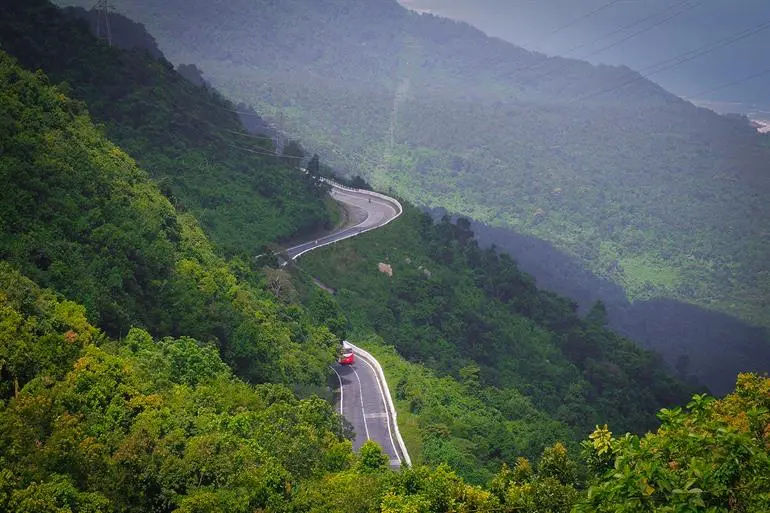
The iconic mountain pass from Danang to Hue in central Vietnam
Known as Sea Cloud Pass, Hai Van Pass has long marked the meeting point of Central Vietnam’s landscape, memory, and movement. The road traces the side of the mountains with quiet confidence, following the curve of the coast as land rises sharply above the water. More than a corridor between Hue and Da Nang, it reflects human resolve shaped into stone and asphalt, a carefully built answer to steep slopes, shifting weather, and unforgiving terrain.
From the highest point, the view opens across Lang Co Bay, the wide East Sea, and the overlapping ridges of the Truong Son range dissolving into haze. Light reshapes the scene throughout the day, clear and sharp in the morning, muted and subdued as clouds roll in later on. Hai Van Pass is not only a place to admire, but a place that carries weight, reflecting the strength, restraint, and quiet confidence of Central Vietnam.
Why riding a motorbike is the best way to experience the Hai Van Pass?
There are many ways to take in Hai Van Pass, but traveling by a motorbike offers the most direct connection to the road itself. Sitting at the controls sharpens every sensation as the route unfolds bend by bend, with shifting light, rising slopes, and open water always in view. The landscape reveals itself gradually, inviting attention rather than rushing past, until mountains, clouds, and coastline feel like parts of a single scene.
Compared with bus or private car travel, this way of crossing the pass allows a slower and more personal rhythm. You choose when to pause, whether to watch clouds gather along the ridgeline, look down toward Lang Co Bay as the light softens, or simply take in the sea air drifting up from below. These pauses give the journey its character, turning short moments into lasting impressions shaped by place and timing.
Practical arrangements have also become straightforward. So many motorbike rental services in Hue and Da Nang now make it easy to plan a one-way trip, including tour options such as 14 day Saigon to Hanoi Motorcycle Tour. Passing through Hue and in Da Nang, or the reverse, feels natural for this route, allowing the focus to remain on the landscape and the quiet satisfaction of moving across one of Central Vietnam’s most distinctive mountain passes.
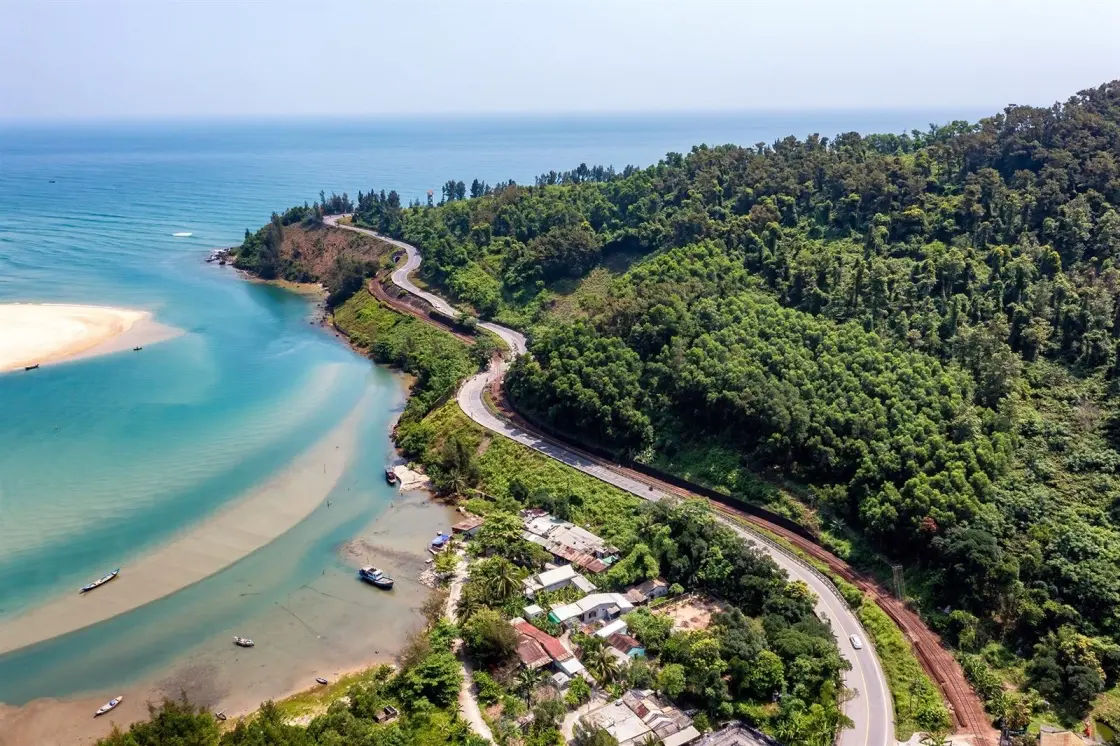
8 great stops along the Hai Van Pass (Suggested by locals)
Traveling across the Hai Van Pass by car or specifically by motorbike is less about speed or challenge and more about awareness. It invites you to slow down, pull over, and take in Central Vietnam as it unfolds from ridge to shoreline. Along this route are places that residents quietly point out to one another, viewpoints and short detours that reward curiosity rather than haste. The following list highlights more than stops worth your time, places that reveal the character of the pass and are best explored while riding with Vietnamese Motorbike Tours (A Local Motorbike tour organizer based in Hanoi, Vietnam).
1. The Nam O Beach
Just north of Da Nang, Nam O Beach serves as a natural starting point for a journey toward Hai Van Pass. The area remains rooted in daily fishing life, known for clear water, dark rocks edged with moss, and a shoreline shaped by routine rather than crowds. Setting out from here, the coastal road guides you calmly toward the base of the pass, easing you into the route with open views and a sense of quiet anticipation before the climb begins.
2. Dark Rock Beach at Nam O
About 15 kilometers from Da Nang, Black Rock Beach lies quietly below the slopes of Hai Van Pass. Large dark stone formations stand against clear blue water, giving the shoreline a raw and slightly secluded feel. The setting appeals to those who prefer calm surroundings, whether for a brief swim, a moment of rest, or a pause before continuing toward the higher stretches of the pass.
3. The Turtle rock viewpoint (Recommended)
The first place many locals and tourists pause when ascending from Da Nang is Turtle Rock, a natural outcrop extending toward the water with a shape that recalls a broad shell. Behind it, the mountains unfold in long layers that seem to recede without end. From this point, the view stretches across Nam O Bay and along the Da Nang coastline, offering a calm moment to stop, take in the open horizon, and notice the mix of sea air and mountain scents.
4. The war era military bunkers
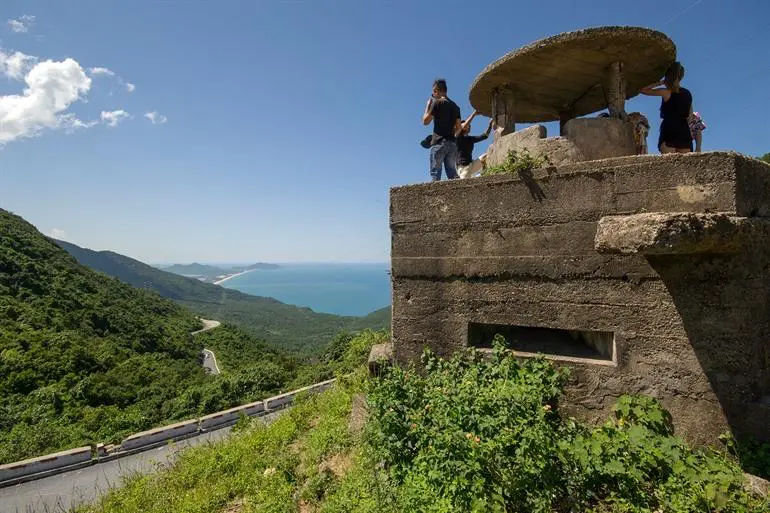
Midway along the ascent, a series of old French bunkers appears through the mist, their stone surfaces softened by moss and damp air. Once positioned as observation posts along the route linking Hue and Da Nang, these structures now sit quietly within the landscape.
There are five bunkers scattered at different points along the pass, each offering a slightly different outlook across sea, slopes, or valley. Two of the most notable positions, FB Los Banos and FB Roy, once oversaw the area north of Lang Co and extended their line of sight toward the Bach Ma mountains. Standing among these weathered walls, often wrapped in fog and stillness, the sense of time feels suspended. The bunkers remain as quiet witnesses to conflict, endurance, and the slow return of nature.
5. Hairpin curve at the summit
Near the highest point of Hai Van Pass, a tight U-shaped curve marks one of the route’s most striking sections. The incline is steep and the space limited, demanding focus as the road turns back on itself. In return, the view opens wide, with clouds moving close by, the sea far below catching the light, and mountain ridges extending into the distance. For many travelers, this stretch becomes the image that stays with them long after the journey ends.
6. Hai Van Gate (Known as Hai Van Quan)
Rising to nearly 500 meters above sea level, Hai Van Gate marks the highest point of the pass and its most historically significant landmark. Constructed during the Tran dynasty and later restored under King Minh Mang, the gate once drew praise from King Le Thanh Tong as the “First Grand View Under Heaven.” From here, the land opens in two directions, with Lang Co Bay stretching toward Hue on one side and Da Nang unfolding on the other. The elevated position makes it a favored place to watch the light change at dawn and dusk, when sky, sea, and mountains gradually come into balance.
7. The war era radar station
Close to the summit, an abandoned radar station sits quietly above the pass, once operated by French and later American forces to observe activity along the central coast. The structure remains largely untouched, drawing in those curious about its past and its isolated setting. From this elevated point, the view stretches across the open East Sea on one side and the Truong Son mountain range on the other, where land and sky appear to merge into a single, expansive scene.
8. Stop at Lang Co Bay
Once you have crossed Hai Van Pass (ride toward Hue), it is worth slowing down rather than turning back right away. Lang Co Bay offers a gentle contrast to the climb, with calm water, open shoreline, and an unhurried pace. A simple coffee by the sea, a meal of freshly prepared seafood, and time spent in the coastal air help ease the effort of the journey. It feels like a natural closing chapter, allowing the experience of the pass to settle before the road continues.
Bottom line: Hai Van Pass by motorcycle
Crossing the Hai Van Pass by motorbike goes beyond simply moving from one place to another. It brings together landscape, history, and personal experience along a route shaped by mountains, weather, and time. The changing light, the rise and fall of the road, and the constant presence of sea and stone leave a lasting impression that defines this part of Central Vietnam.
For travelers looking to experience the Hai Van Pass in a direct and meaningful way, traveling with a trusted Motorcycle Tour organizer in Vietnam a clear and well-supported option. The journey emphasizes awareness, connection, and respect for the environment rather than speed or spectacle. By the time the pass is behind you, what remains is not only a completed route, but a deeper understanding of the land and the quiet satisfaction of having experienced one of Vietnam’s most iconic mountain roads in its fullest form.