
Vietnam Currency Guide: Money, Payments, and ATMs for Travelers
Vietnam’s currency is the Vietnamese Dong, written as VND or ₫, and it comes in banknotes only, coins were phased out of everyday use back in 2011. The exchange rate sits somewhere around 26,000 to 27,000 VND to one US dollar, though that number moves daily, so a 100,000 VND note is worth roughly US$4, not the small fortune the extra zeros make it look like.
This guide covers what the money actually looks like, where to get it, how to pay for things day to day, and a few points specific to travelers riding around the country on a motorbike rather than moving between hotels by taxi. The goal is straightforward: understand the Dong before you land, not while you’re standing at a market stall trying to work out if you just handed over 20,000 or 500,000.
Quick Facts: Money in Vietnam
| Detail | Answer |
|---|---|
| Currency | Vietnamese Dong (VND, ₫), issued by the State Bank of Vietnam |
| Coins | None in everyday circulation, all transactions use banknotes |
| Highest Note | 500,000 VND, worth roughly US$19-20 |
| Best Foreign Currency to Bring | US Dollars, by far the easiest to exchange |
| Card Acceptance | Common in hotels, malls, and upscale restaurants, rare at markets, street food stalls, and rural businesses |
| Daily Cash to Carry | Roughly 500,000 VND to 1,000,000 VND for food, transport, and small purchases |
| Cash Declaration Threshold | Must declare over US$5,000 or 15,000,000 VND at customs |






Understanding Vietnamese Dong Notes
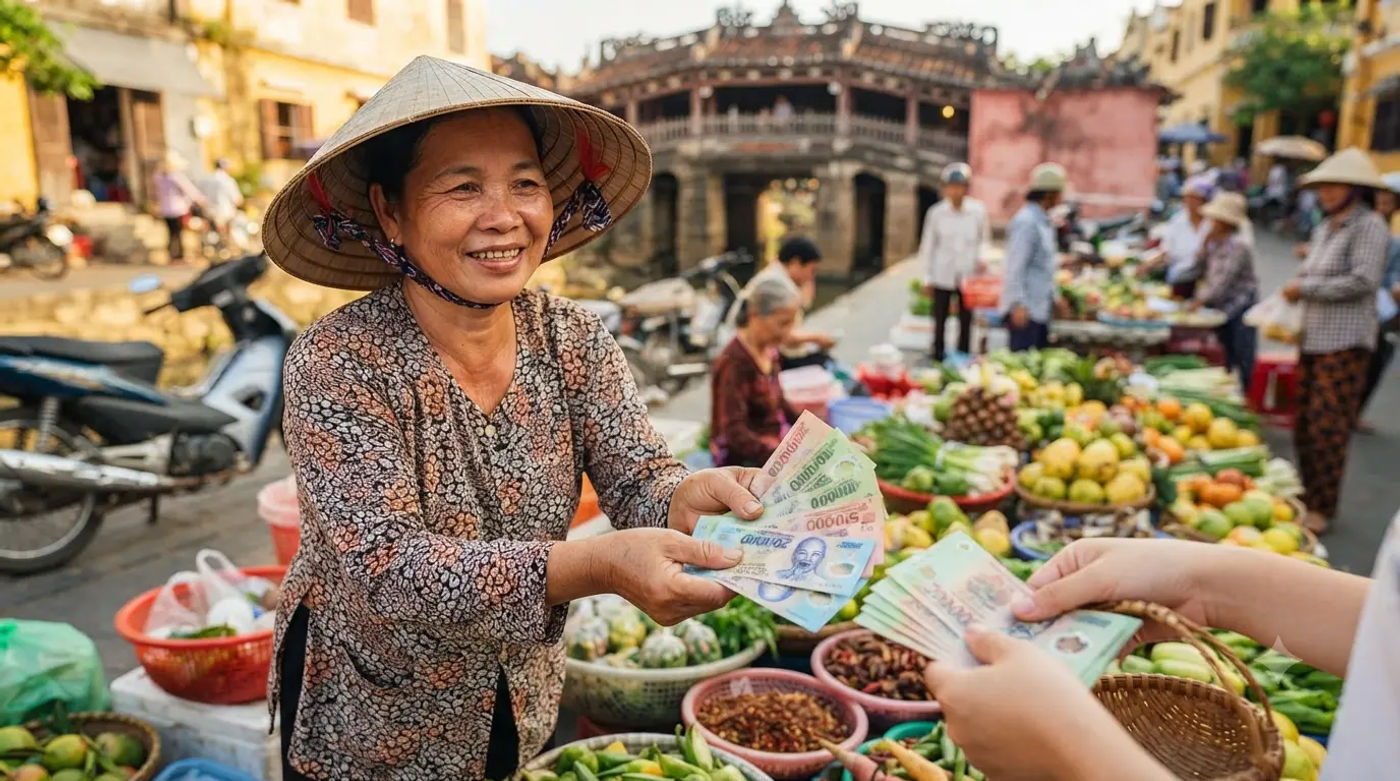
Every note in regular use is polymer: 10,000, 20,000, 50,000, 100,000, 200,000, and 500,000 VND. Older cotton-paper notes in 1,000, 2,000, and 5,000 VND still turn up occasionally for very small costs like parking or bus fares, but you’ll use them rarely. Locals also shorten larger amounts in conversation, “20k” for 20,000 VND, “500k” for 500,000, and menus and price tags often follow the same shorthand.
The two mix-ups worth knowing before you start paying for things: 20,000 and 50,000 VND notes are both blue-green and easy to confuse in a dim room or a moving taxi, and 20,000 VND can also get mistaken for the 500,000 VND note since both share a similar blue tone despite the very different value. A simple habit fixes both problems: keep 100,000 VND and above in one section of your wallet, smaller notes in another, and check the number printed on the note rather than judging by color alone.
Each note also carries its own landmark, which doubles as a quick way to double check what you’re holding: the 20,000 VND note shows the Japanese Covered Bridge in Hoi An, the 100,000 VND note shows the Temple of Literature in Hanoi, and the 200,000 VND note shows Ha Long Bay.

Why Vietnamese Prices Have So Many Zeros
A bowl of pho for 60,000 VND looks alarming until you understand the history behind the number. Vietnam went through a period of severe inflation during the 1980s, and rather than redenominating the currency by dropping zeros, the government simply kept issuing larger notes over time, eventually reaching the current 500,000 VND note. The result is a currency where everyday purchases carry more digits than most travelers are used to, but the actual cost stays low.
A fast way to estimate prices without doing full conversions: drop the last three zeros from a VND amount, then divide by roughly 25 for a US dollar estimate. So 100,000 VND becomes 100, divided by 25 is about US$4. It’s not exact, since the real rate moves daily, but it’s close enough for shopping, ordering food, or negotiating at a market stall.
Cash, Card, or QR Code: What Actually Works
Vietnam runs on a mix of all three, and none of them cover everything on their own. Cash remains the most reliable option across the board and the only option in many places: street food stalls, local markets, small family-run shops, motorbike parking, and rural businesses outside the main tourist areas generally don’t take cards or QR payments at all.
Cards work well in hotels, shopping malls, supermarkets, convenience store chains, mid-range and upscale restaurants, and most tourist attractions, with Visa and Mastercard the most widely accepted. Some smaller hotels and tour operators add a 2 to 3 percent surcharge for card payments, so it’s worth asking before you tap.
QR code payment is everywhere in Vietnam now, but most of the local systems (MoMo, ZaloPay) are built around Vietnamese bank accounts and aren’t practical for short-term visitors. Travelers from Thailand and Cambodia can pay directly through their own banking apps via VietQRGlobal, and travelers from South Korea and China have similar direct options. For visitors from the US, Europe, Australia, and Canada, the more workable routes are the VNPAY app, which lets you register with an international phone number and passport and link an international card, or Wise, which can scan supported local QR codes through its Alipay+ integration.
Getting Cash: ATMs and Currency Exchange
ATMs are easy to find in Hanoi, Ho Chi Minh City, Da Nang, Hoi An, and Nha Trang, and most international Visa, Mastercard, Cirrus, and Plus cards work without issue. Withdrawal limits usually sit between 2 and 5 million VND per transaction, and local ATM operators typically charge 50,000 to 100,000 VND per withdrawal on top of whatever your home bank charges for foreign transactions. Withdrawing a larger amount less often keeps these fees from adding up, and a few banks, including VPBank and TPBank, are known among travelers for lower or waived local ATM fees on foreign cards.
One setting matters more than people expect: when an ATM or card terminal asks whether you’d like to pay or withdraw in your home currency instead of VND, always choose VND. That prompt is Dynamic Currency Conversion, and it almost always applies a worse exchange rate than your own bank would give you.
If you’d rather exchange physical cash, US dollars are by far the easiest currency to convert, with Euros a distant second and British Pounds, Canadian Dollars, and Australian Dollars accepted in fewer places and usually at weaker rates. Banks offer the most secure exchange (bring your passport, and expect to go during weekday business hours), while licensed exchange counters and gold shops in city centers, such as the currency-exchange streets found in Hanoi’s Old Quarter and around District 1 in Ho Chi Minh City, tend to offer better rates with no commission, provided they’re properly licensed. Airport counters are the most convenient option right after landing but usually have the weakest rates, so changing US$50 to US$100 on arrival for your first taxi and meal, then exchanging the rest in the city, is a reasonable approach.
Managing Money on a Motorbike Trip
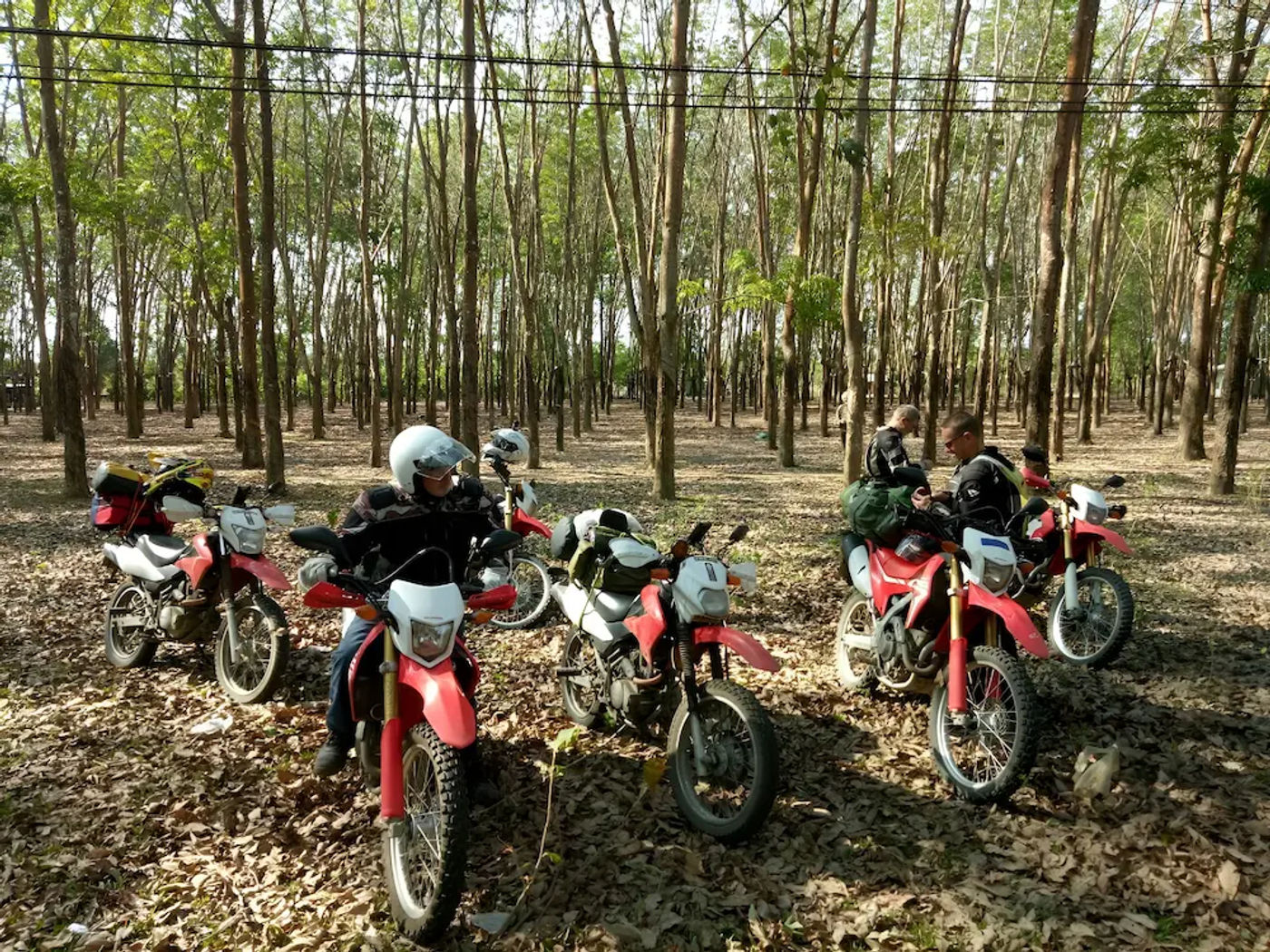
Riding around Vietnam rather than moving between hotels by taxi changes a few things about how you carry money. Petrol stations, even the small roadside ones outside major towns, are cash-only in most cases, so keep a stock of smaller notes rather than relying on a card working at the pump. The same goes for motorbike parking attendants, who almost always want a few thousand VND in cash and won’t have change for a 500,000 VND note.
If you’re renting a motorbike rather than riding with a guided group, ask upfront whether the rental shop wants a cash deposit, a passport held as security, or both, since this varies by shop and region. Rural roadside food stalls, the kind you’ll actually want to stop at between towns, are almost always cash-only as well, so it’s worth carrying more small denominations than you think you’ll need once you’re outside Hanoi, Ho Chi Minh City, or Da Nang.
For travelers riding with a guide rather than self-driving, the same tipping guidance applies as any private driver or tour guide, a few hundred thousand VND at the end of a full riding day is a reasonable way to show appreciation for good service, though it’s never expected.
Avoiding Common Money Scams
Transportation is where most visitors run into overcharging. Some taxi drivers skip the meter, take a longer route than necessary, or quote an inflated flat rate, particularly near airports and train stations. Ride-hailing apps like Grab, Be, or Green SM solve most of this by showing the fare before you book and tracking the route by GPS. One variation worth watching for: a driver showing you a “Grab price” on their own phone after deliberately selecting a premium vehicle category to justify a higher fare, always check the price on your own phone rather than theirs. If you do take a traditional taxi, confirm the meter is running, and for a motorbike taxi (xe om), agree on the price before the ride starts.
The other scam worth knowing involves the notes themselves. Because several denominations share similar blue tones, particularly 20,000 against 50,000 and 20,000 against 500,000, a dishonest vendor may swap the note you handed over and claim you paid less than you did. A related trick is the “no change” excuse for a large bill, hoping you’ll either overpay or buy something extra to make up the difference. Saying the denomination aloud as you hand over cash, keeping large notes separate from small ones, and breaking 500,000 VND notes at a supermarket or convenience store before heading to a market stall all but eliminate these situations.
Tipping and Haggling
Tipping isn’t part of Vietnamese culture by default and is never expected at restaurants or in taxis, but it’s genuinely appreciated when a guide, driver, or service worker has done a good job. As a rough guide: 20,000 to 50,000 VND for hotel bellhop or housekeeping service, 100,000 to 200,000 VND for a full-day tour guide, 50,000 to 100,000 VND for a full-day private driver, and 50,000 to 100,000 VND (or around 20 percent for exceptional service) for a spa or massage therapist. If you’re staying somewhere for several nights, a small daily tip for housekeeping works better than one lump sum at the end, since different staff may clean your room on different days.
Haggling is a normal part of shopping in Vietnamese markets, more so than in neighboring Laos or Cambodia, and it’s generally good-natured rather than adversarial. A friendly tone gets further than aggressive bargaining, and it helps to compare prices at two or three stalls before settling on what feels fair. Keep some perspective on scale too, the last 10,000 VND you’re negotiating over is worth far more to the seller than it is to you.
Bringing Cash Into Vietnam
Most travelers never need to think about customs declarations, but the rule matters if you’re carrying a large amount: anyone entering or leaving Vietnam with more than US$5,000 (or the equivalent in another currency) or 15,000,000 VND must declare it on arrival or departure. Skipping the declaration when you’re over the threshold can lead to a real fine, so it’s worth filling out the form if you’re anywhere close to the limit rather than risking it.
FAQs
What currency does Vietnam use?
The Vietnamese Dong (VND, ₫), issued by the State Bank of Vietnam. Coins are no longer used in everyday transactions.
Can I use US dollars in Vietnam?
Rarely for everyday purchases. A few hotels and tour operators may accept USD, but almost all transactions, from meals to motorbike rentals, are priced and paid in VND.
How much cash should I carry each day?
Roughly 500,000 to 1,000,000 VND covers most days of food, transport, and small purchases, with more useful if you’re riding through rural areas where cards aren’t accepted.
Is Vietnam a cash-based country?
Mostly, yes, despite fast-growing QR code adoption. Cash is still essential for markets, street food, rural areas, motorbike parking, and small family-run businesses.
Should I tip in Vietnam?
It’s not expected, but appreciated for tour guides, private drivers, and good service. A tip of 50,000 to 200,000 VND for a full day of guiding or driving is a reasonable range.
Bottom line
Vietnamese Dong looks confusing on the first day and becomes second nature by the second. Carry a mix of small and large notes, keep a card for hotels and malls, decline currency conversion prompts at ATMs, and you’ll spend far less time worrying about money and more time actually looking at the country.
Planning to see more of Vietnam from the seat of a motorbike rather than the back of a taxi? Check out Guided motorbike tours in Vietnam with IRTouring, and let someone else handle the route planning while you handle the riding.