
Honda CRF300L vs CRF300 Rally vs CRF300F: Full Comparison
Honda currently builds three separate 300cc off-road-capable models, and they aren’t the same bike wearing different plastics. The CRF300L is a street-legal dual-sport built for mixed road and trail riding, the CRF300 Rally is the same platform dressed in adventure-style bodywork with a beginner-focused setup, and the CRF300F is a purpose-built off-road trail bike with no street equipment at all. Reviewers consistently land on the same verdict across all three: soft, beginner-friendly suspension, a mellow torquey engine, and genuine Honda reliability, with the real differences showing up in weight, ground clearance, and where each bike is actually allowed to go.
If you’re trying to work out which one fits a specific kind of riding, whether that’s commuting with weekend trail access, learning to ride off-road for the first time, or picking a bike to tour rough roads on, here’s how the three compare, and where each one runs out of ability.
- Check out Vietnam motorbike tours




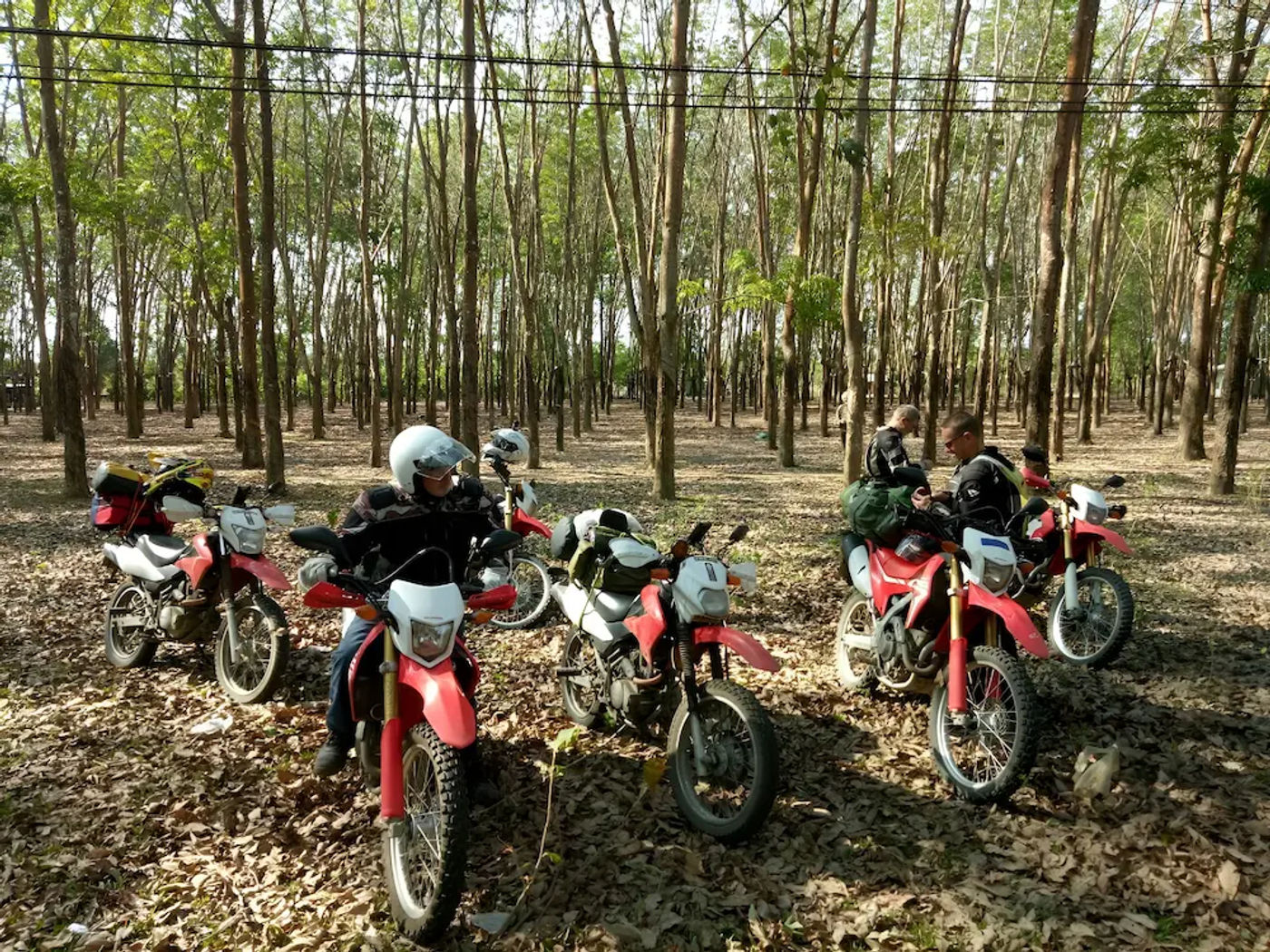
Quick Comparison: CRF300L vs CRF300 Rally vs CRF300F
| Spec | CRF300L | CRF300 Rally | CRF300F |
|---|---|---|---|
| Category | Street-legal dual-sport | Street-legal adventure-styled dual-sport | Off-road trail bike, no street equipment |
| Engine | 300cc liquid-cooled single, torque-focused low-to-mid range | 286cc liquid-cooled single, 26 hp / 26.1 Nm | 294cc air-cooled single, roughly 24 hp |
| Transmission | 6-speed | 6-speed, wet multiplate assist/slipper clutch | 6-speed (new for 2026, up from 5-speed on the outgoing CRF250F) |
| Front Suspension | 43mm fork, 10.2 in travel, non-adjustable, soft | 43mm USD fork, 234mm (9.2 in) travel, non-adjustable, very soft | 41mm Showa fork, 9.5 in travel, improved over the previous model but still forgiving |
| Rear Suspension | Soft shock, more controlled than the front, bottoms on big hits | Pro-Link shock, 260mm (10.2 in) travel, comically soft for experienced riders | Pro-Link shock, 9.1 in travel, aluminum shock mount, firmer without harshness |
| Weight | Heavier than most in its class, stable but tiring to muscle around off-road | 152 kg kerb weight, notably light for the segment | 273 lbs (about 124 kg) claimed curb weight |
| Fuel Range | Not specified, comfortable cruising to around 55 mph | 12.8 L tank, past 300 km for everyday riding | 1.6 gal tank, built for short off-road sessions rather than long-distance riding |
| Price (approx.) | Budget-friendly entry-level dual-sport pricing | Around $10,500 ride away (AUD) | $4,999 MSRP (USD) |
Engine and Power: The One Thing All Three Share
Every version of the CRF300 platform is tuned the same way: torque low in the rev range, a mellow delivery, and nothing that will catch a new rider off guard. The CRF300L’s liquid-cooled 300cc engine does its best work in the bottom to mid-range and stays comfortable cruising to around 55 mph, with the engine starting to feel strained past 60-65 mph. The CRF300 Rally uses a slightly smaller 286cc liquid-cooled version making 26 hp and an equal number of Nm, described as “absolutely no fuss” rather than exciting, paired with notably short gearing that favors trail lugging over highway speed.
The CRF300F breaks from the other two by staying air-cooled rather than liquid-cooled, at 294cc and roughly 24 hp, up from about 20 hp on the outgoing CRF250F. The bump came with a larger bore, a new oil cooler to manage the extra heat, and a heat-resistant clutch upgrade, plus the platform’s first six-speed gearbox, replacing the outgoing model’s five-speed. None of the three are engines built to get a rider into trouble quickly, and that’s clearly the intended design across the whole lineup rather than a limitation of any single model.
Suspension: Soft Is the Family Trait
If there’s one complaint that shows up in every CRF300 review, it’s the suspension. The CRF300L’s 43mm fork uses all 10.2 inches of travel on anything that loads the front end hard, and reviewers who tested it on full knobby tires still called the suspension the weakest part of the build, even for novice riders. The CRF300 Rally goes even softer: its non-adjustable 43mm fork is described as “comically soft” for an experienced rider, bottoming out at both ends if pushed, though that same softness gives beginners a forgiving margin for error and, according to one review, surprising rear-end grip from the weight transfer under acceleration.
The CRF300F is the one exception showing real movement. Compared to the CRF250F it replaces, the fork travel grew from 8.5 to 9.5 inches, and the rear shock mount switched from steel to aluminum for better stiffness without added weight. Reviewers noted the front end feels more controlled with less dive, and the rear shock tracks small chatter better, calling the change “night and day” from the previous generation, even though the suspension still isn’t in true intermediate-or-above territory.
Weight and Handling On the Trail
Weight is where the three bikes separate the most clearly. The CRF300 Rally’s 152 kg kerb weight is repeatedly called out as a major advantage, making the bike feel light and unintimidating on technical singletrack, and lighter than heavier adventure-styled competitors like the Royal Enfield Himalayan or CFMoto 450MT. The CRF300F, at a claimed 273 lbs (about 124 kg), rides even lighter still, helped by improved geometry and engine mount tuning that reviewers say makes the bike disappear underneath you once it’s rolling.
The CRF300L sits at the heavier end of its class by comparison. That extra weight adds stability on the road and on fire roads, but reviewers noted it takes real strength to right the bike once it starts tipping, and muscling it through technical terrain wears a rider down faster than the lighter Rally or F. None of this makes the CRF300L a poor choice, it simply performs best on smooth fire roads, smooth trails, and technical singletrack rather than terrain that demands frequent picking up and repositioning.

Street Legal or Off-Road Only: Where Each Bike Actually Fits
This is the detail that matters most if you’re choosing between the three for anything beyond weekend trail riding. The CRF300L is a fully street-legal dual-sport, licensed for road use and built to handle commuting, longer rides, and mixed terrain in the same day. The CRF300 Rally is also street-registered, sold “ride away” with on-road pricing, and functions as a lighter, more trail-capable alternative to Honda’s bigger adventure bikes like the Africa Twin or Transalp, even if the “Rally” name and HRC sticker overstate its race pedigree.
The CRF300F sits in a different category entirely. It’s built and positioned as an off-road trail bike rather than a street-registered dual-sport, with a minimal instrument cluster (just a low fuel light) and no road-going equipment, which puts it firmly in the category of bikes meant for trails, tracks, and private land rather than road touring.
Good and Bad, Side by Side
| CRF300L | CRF300 Rally | CRF300F |
|---|---|---|
| Street-legal, genuinely capable on mixed road and trail routes | Lightest of the three street-legal options, very confidence-inspiring off-road | Best value in the lineup at $4,999, with the most improved suspension of the three |
| Heavier than the Rally or F, tiring to muscle on technical terrain | Build quality feels budget up close, uncomfortable seat on longer highway stretches | Not street-legal, limited to off-road use only |
| Learner-friendly engine, hard to get into trouble with the throttle | Surprising rear-end grip from its soft suspension setup | New 6-speed gearbox and oil cooler address the outgoing model’s biggest weaknesses |
| Soft suspension bottoms out on rockier, faster off-road terrain | Non-adjustable suspension will need upgrading as a rider’s skill improves | Minimal instrumentation, small fuel tank limits it to short off-road sessions |
So Which CRF300 Is Actually the Best Off-Road Bike?
There isn’t a single winner, because the three bikes aren’t competing for the same job. For pure off-road capability on a budget, the CRF300F has the most improved suspension and the lightest claimed weight of the three, but it can’t leave the trailhead on public roads. For a beginner who wants the lightest, most forgiving platform that’s still road-registered, the CRF300 Rally’s low weight and soft, grip-friendly suspension make it the easiest of the three to build confidence on. For anyone who needs one bike to handle both a daily commute and a weekend trail ride, or a longer multi-day route that mixes pavement, gravel, and rougher back roads, the CRF300L remains the most practical all-rounder, even carrying a weight penalty the other two don’t have.
Who Each Bike Is For
The CRF300L suits riders who want one motorcycle for commuting, road-based touring, and light-to-moderate off-road riding, including routes like the Ha Giang Loop, where rough tarmac and unfinished mountain roads are more common than technical dirt track. The CRF300 Rally suits beginner off-road riders, or shorter and lighter riders specifically, who want a road-legal bike that still feels genuinely at home on a trail. The CRF300F suits riders who already have a street bike and want a dedicated, affordable trail machine for weekends at the track or on private land, without needing any road-going capability at all.
FAQs
Is the Honda CRF300L good off-road?
It handles smooth fire roads, smooth trails, and technical singletrack reasonably well, and its torquey engine can mask some rider error in throttle and clutch control. Its suspension and above-average weight for the class are the main limits on rockier, faster off-road terrain.
Is the Honda CRF300 Rally a race bike?
No. Despite the “Rally” name and HRC sticker, its power output and non-adjustable suspension are built for beginner and lighter riders rather than competitive off-road riding.
Is the Honda CRF300F street legal?
It’s positioned as an off-road trail bike rather than a street-registered dual-sport, with minimal instrumentation and no road-going equipment, so it isn’t built for public road use.
Which CRF300 is best for a beginner?
All three are built with beginners in mind, but the CRF300 Rally and CRF300F are both notably lighter than the CRF300L, which makes them easier to manage while a new rider is still building confidence off-road.
Which CRF300 is best for touring rough roads?
The CRF300L, since it’s the only one of the three built for both road use and mixed-terrain touring in the same trip.
Bottom line
All three CRF300 models share the same easygoing engine character and the same soft, forgiving suspension that defines Honda’s entry-level off-road lineup. Where they split is weight, road legality, and what kind of riding day they’re actually built for: the F for dedicated trail use, the Rally for a lighter road-legal trail bike, and the L for riders who need one motorcycle to do it all.
Planning to ride mixed terrain on a real touring route rather than a weekend trail? Check out Guided motorbike tours in Vietnam with IRTouring, where the road conditions, not the spec sheet, decide which bike actually makes sense.