

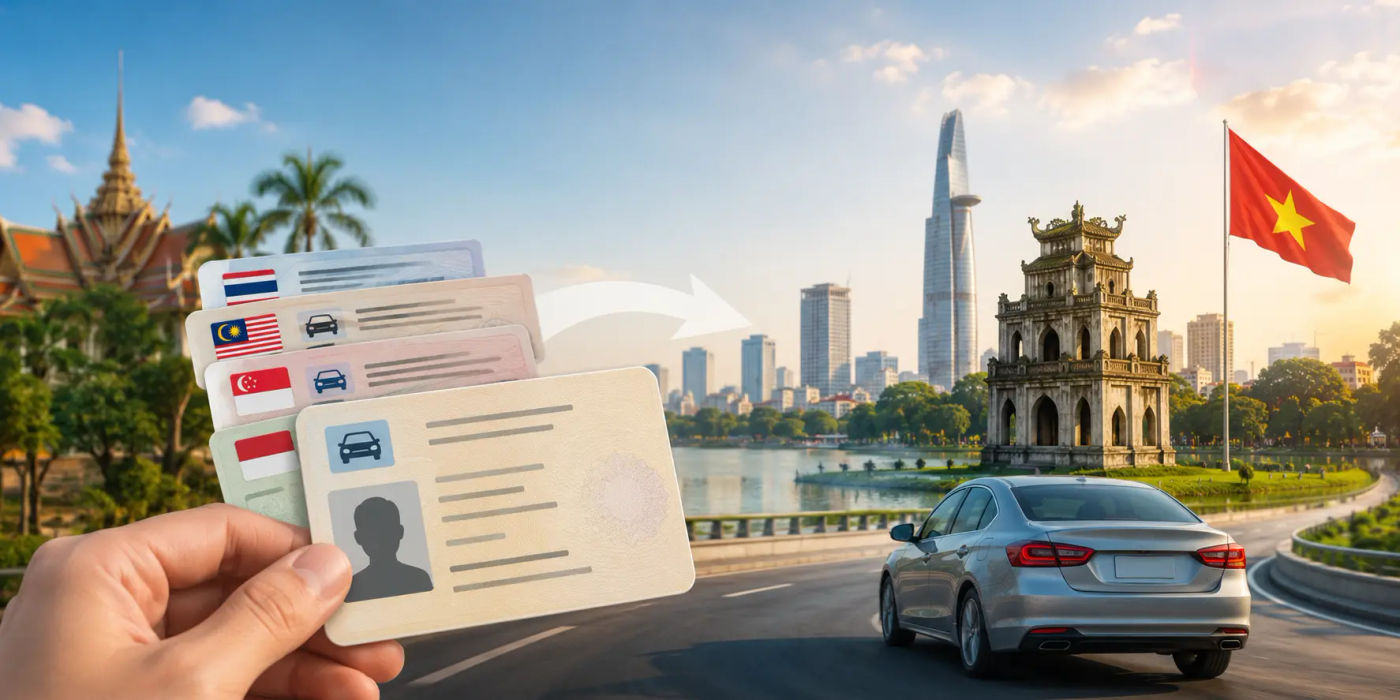
How to Convert an ASEAN Driving License for Vietnam
To convert an ASEAN driving license into a Vietnamese one, you’ll need notarized paperwork and submit your application to the Hanoi Department of Transport. The process takes about 5 to 14 days and costs roughly 135,000 VND (~USD 6)
If you’re asking what is the process to convert an ASEAN driving license for use in Vietnam, the short answer is: it’s an administrative exchange with no written test, no riding assessment, and a manageable document checklist, but only if you meet the residency threshold. A lot of ASEAN nationals arrive assuming the regional license recognition agreement means they’re good to go from the moment they clear immigration. The logic feels solid. But the reality has more layers to it, and getting those layers wrong can mean fines, an impounded bike, or a bureaucratic detour that costs you half a week of riding time.
There are two distinct situations you might be in. If you’re a long-term resident of Vietnam with a Temporary Residence Card, the formal conversion route is available to you and gives you a full Vietnamese license. If you’re a short-term visitor passing through for a few weeks, the conversion process doesn’t apply to you at all, and a different set of rules governs your road legality. Knowing which category you fall into before you arrive saves you from chasing the wrong process. Many reputable guided tour operators provide pre-departure legal briefings so you know exactly what to carry before your first kilometer on Vietnamese tarmac.
This guide covers the official process to convert an ASEAN driving license for use in Vietnam: who qualifies, what documents to prepare, where to submit the application, how much it costs, and the specific mistakes that cause delays. Whether you’re planning to stay long-term or just need clarity before a riding holiday, read this before you do anything else.
What is the process to convert an ASEAN driving license for use in Vietnam?
The license conversion process in Vietnam is an administrative exchange, not a test. There’s no theory exam, no practical riding required. What there is, however, is a residency threshold that catches most ASEAN applicants off guard.

The three-month residency requirement
To qualify for a foreign driver’s license conversion in Vietnam, you must have resided in the country for a minimum of three months and hold a valid Temporary Residence Card (TRC) with at least three months of remaining validity. Being physically present in Vietnam on a tourist visa doesn’t meet this threshold. The residency rule applies equally to ASEAN nationals regardless of any mutual recognition arrangements; those agreements govern short-term driving rights, not the conversion pathway.
License types that can’t be converted
Not every license qualifies as a source document. Vietnam explicitly excludes temporary foreign licenses, International Driving Permits (IDPs) of any type, expired or damaged licenses, and licenses issued by bodies not recognized under Vietnamese law. Your home-country license must be a full, valid, current national license. On vehicle categories: a car license does not automatically authorize you to ride a motorcycle. The category endorsement on your original license must match the vehicle class you want to operate in Vietnam. If your ASEAN license only covers cars, your Vietnamese conversion will cover only cars.

Documents you need to gather before your appointment
Showing up at the Department of Transport with full document in hand. Vietnam’s licensing offices process what’s in front of them; they don’t make exceptions for missing paperwork. Prepare everything on this list before you book your submission date.
The full document checklist
For a standard foreign driver’s license conversion in Vietnam, you will need:
- Completed application form (available at the licensing office or on the provincial Department of Transport website)
- Original ASEAN/foreign driver’s license for verification, plus a clear copy
- Certified Vietnamese translation of your driving license
- Passport copy and visa or entry stamp page copy
- Valid Temporary Residence Card (TRC) copy
- Health certificate issued by an authorized Vietnamese medical facility
- Two to four passport-size photos (3×4 cm, white background)
One note on the health certificate: some applicants converting within the active validity period of their TRC may find this requirement waived by the local office. Confirm directly with the Department of Transport where you’ll be submitting, because this varies by province.
The 2026 the all-inclusive North Vietnam motorbike tour packages runs a wider range than most riders expect. Short-format 3-day Ha Giang Loop tours start from around $189 per person for a small group with a guide. At the other end, a 7-day fully supported North Vietnam motorcycle tour can reach $1260 total for a group departure, with accommodation, bike and fuel, guide and daily refreshing.
Getting your license translated and notarized
The Vietnamese translation of your ASEAN license must be certified by a licensed Vietnamese notary office or by a Vietnamese embassy or consulate abroad. A basic printed translation from an online tool won’t be accepted.
For options on getting an accepted, certified translation, see certified driver’s license translation services. Turnaround times vary by provider; many notary offices in Hanoi and Ho Chi Minh City report completing the work in one to two working days. The cost at a Vietnamese notary office generally runs between VND 300,000 and VND 500,000 depending on the language pair and whether the provider bundles translation and notarization into a single service.
Budget for this separately from the government fee, since it’s the largest single expense in the process. Note that if your ASEAN license already includes English-language text, some authorities may not require a translation at all. Check with your local Department of Transport before commissioning one.
Step-by-step: the process to convert an ASEAN driving license for use in Vietnam
Once your dossier is complete, the submission itself is a straightforward counter visit. The back-and-forth that frustrates most applicants happens before this step, not during it.
Where to go
Foreign driver’s license conversions are processed by the Department of Transport (Sở Giao thông Vận tải) in the city or province where you hold your registered residence.
- In Hanoi, that’s the Hanoi Department of Transport at 16 Cao Bá Quát, Đống Đa.
- In Ho Chi Minh City, it’s the HCMC Department of Transport at 252 Lý Chính Thắng, Quận 3.
Traffic police stations handle enforcement, not license issuance, so don’t head there for this application.
What happens after you submit
On submission day, staff verify your original documents against your copies, confirm your residency status, and photograph you on-site. If your dossier is complete, it moves to centralized processing within one working day. The licensing authority then has three working days to approve and produce the license, after which the provincial DoT prints and releases it. Under normal conditions, the full turnaround from submission to collection runs five to seven working days. If your immigration status needs additional verification, that window can extend, so submit as early in your stay as your schedule allows.
Fees and what to actually budget
The government fee is small, the real out-of-pocket cost is higher once you account for translation, photos, and the health certificate.
The Vietnamese government charges VND 135,000 for the conversion application, which works out to roughly $5 to $6 USD at current rates. Pay this directly at the DoT counter on submission day. There are no tiered rates based on nationality or vehicle class.
The real total, once you add certified translation and notarization, health certificate, photo printing, and document copying, sits between $20 and $40 USD for most applicants. If you hire an intermediary agent to manage the paperwork on your behalf, add another $30 to $80 to that estimate. For first-timers unfamiliar with how Vietnamese administrative offices work, using a reputable agent can save you from a second or third trip due to minor dossier errors.
Common mistakes
There’s a short, predictable list of failure points in this process. Nearly all of them are avoidable with a little preparation.
TRC validity issues
The most frequent reason applications are turned away is a Temporary Residence Card with less than three months of remaining validity. Applicants who present an expiring TRC, or who attempt to substitute it with a tourist visa, are rejected at the counter. If your TRC is close to expiry, extend it before you apply. Check the expiry date on the card itself, not on your last entry stamp; those are different documents with different timelines, and confusing them is a common error.
IDP misconceptions
Many ASEAN riders carry an International Driving Permit and assume it covers them for all driving in Vietnam. It doesn’t work that way. Vietnam only recognizes IDPs issued under the 1968 Vienna Convention, and only when carried alongside the original home-country license. A 1949-convention IDP is not accepted. More critically, no IDP of any type can be used as a source document for the conversion process.
If your license is currently only documented as an IDP, you’ll need to obtain the full original national license from your home country before applying for a Vietnamese conversion. For details on which IDPs are recognized and what to carry, consult the country-specific IDP guidance for Vietnam at International Driving Permit requirements for Vietnam.
What short-term riders and tour guests need to know
If you’re visiting Vietnam for two to four weeks, the residency requirement means you’re not eligible for the formal conversion process. That’s not a problem; it just means a different set of rules applies to you. Under the ASEAN mutual recognition arrangement, nationals of ASEAN member states can legally drive in Vietnam using a valid home-country license in the appropriate vehicle category.
In practice, carrying your original license along with a certified translation is strongly advisable. Enforcement varies by region and officer, and being able to present a clear, translated document at a roadside check resolves most situations quickly.
For riders joining an organized motorcycle tour itinerary, the compliance question is handled before you ever reach the road. Vietnam Motorbike Tours includes documentation guidance in every pre-departure briefing, walking international guests, ASEAN nationals included, through exactly what to carry and present if stopped. On remote routes through Ha Giang or along the Ho Chi Minh Trail, where you’re far from any consulate or translation office, knowing your paperwork is in order before you leave the guesthouse makes the day’s riding considerably more relaxed. That peace of mind is what a good guided tour delivers.
For an overview of local requirements and enforcement, read more about Motorcycle Riding Laws in Vietnam for Foreign Tourists.
Before you ride: the short version
Now that you know what the process to convert an ASEAN driving license for use in Vietnam involves, the path forward is clear. The core checklist isn’t long: a valid home-country license, a certified Vietnamese translation, your passport, a valid TRC, a health certificate, and passport photos. The official government fee is about $5 to $6 USD. Processing typically runs one working week under normal conditions.
Where applications fall apart is almost always on the residency documentation. If your TRC is valid and your dossier is complete, the process works as described. If you’re a short-term visitor, the conversion route isn’t the right path, understanding your rights under the ASEAN mutual recognition arrangement and carrying the right documents on every ride is what matters.
For additional official-style explanation and procedural updates, see practical guidance compiled by immigration and licensing observers at how to convert driver license for foreigner living in Vietnam.
Get your documentation sorted before your wheels hit Vietnamese tarmac and carry certified copies on every day of riding. If you’re planning a motorcycle tour through Vietnam and want expert guidance on riding legally through some of the most spectacular routes in Southeast Asia, reach out to Vietnam Motorbike Tours to talk through your itinerary and documentation needs before you book a flight.